German policy affects industrial electricity costs through several separate measures, including the targeted industrial electricity price scheme, electricity-tax relief, grid-fee support, and electricity-price compensation. These measures address different parts of the electricity-cost burden and do not create one universal subsidized tariff for German industry.
The distinction is important because the 5 ct/kWh figure often associated with the industrial electricity price is not a complete delivered price. It is a floor used within the calculation of one temporary support scheme. Network charges, taxes, levies, supplier costs, and unsupported consumption remain relevant.
For how these prices have developed over time, see How Has the Industrial Electricity Price in Germany Developed?.
What Does the German Government Mean by "Industrial Electricity Price"?
The German government uses "industrial electricity price" to describe a temporary compensation mechanism for eligible electricity-intensive sectors, not a guaranteed 5 ct/kWh market tariff. For the full policy background and definition, see Industrial Electricity Price in Germany.
What matters for your bill: the 5 ct/kWh figure is a price floor. The state compensates the gap between the official reference price and this floor, applied to 50% of eligible consumption. It is not the final price paid for all electricity consumed by an eligible company. (Source: German Federal Ministry for Economic Affairs and Energy, BMWE.)
How Is the 2026 Industrial Electricity Price Calculated?
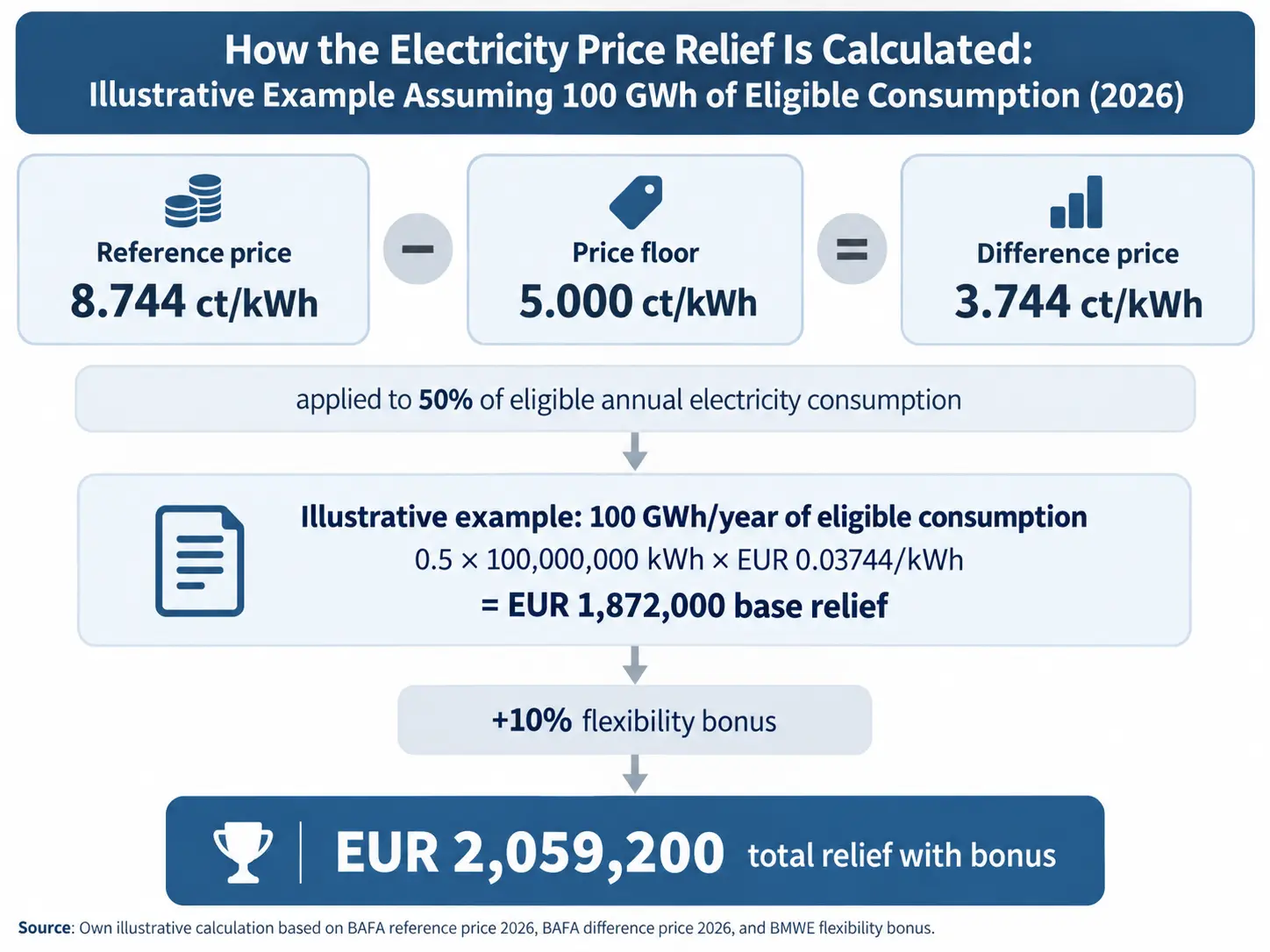
The targeted support scheme applies to the accounting years 2026 through 2028. For 2026, the official reference price is €87.44/MWh, equivalent to 8.744 ct/kWh. The target-price floor is €50/MWh, equivalent to 5 ct/kWh. This produces a difference price of €37.44/MWh, equivalent to 3.744 ct/kWh. [Sources: BAFA; EEX.]
The aid covers up to 50% of eligible annual electricity consumption at the supported price difference. A flexibility bonus can increase the aid amount by up to 10% of the base aid, taking the 2026 relief to approximately 4.1 ct/kWh on the supported consumption volume. [Source: BMWE.]
An eligible company continues to pay applicable grid charges, taxes, levies, supplier costs, the unsupported share of consumption, and any procurement costs remaining after compensation. The support amount is also independent of the company’s individual electricity supply price because it is calculated from the official reference price.
Who Is Eligible, and How Do Companies Apply?
Eligibility is based on the economic activity assigned to the relevant production site, not on high electricity consumption alone. The initial scope covers 91 sectors and subsectors with a significant relocation risk, with potentially around 9,500 companies. This includes parts of the chemical, rubber, plastics, glass, metals, cement, battery, and semiconductor industries. [BMWE, Pressepapier, April 16, 2026.]
The applying company must be a legally independent entity with its registered seat in Germany. The relevant consumption point (Abnahmestelle) must be located in Germany and associated with a production site assigned to an eligible sector under the applicable classification. Companies in difficulty and companies subject to unresolved recovery orders are excluded under the funding guideline. [Sources: BAFA; Federal Gazette funding guideline.]
Applications for the 2026 accounting year will be submitted retroactively in 2027 through BAFA. Portal registration and the creation of draft applications are expected to become possible from December 2026. The regular application deadline for the 2026 accounting year is March 31, 2027. For applicants that are also eligible for electricity-price compensation for the same accounting year and intend to apply for it, the application deadline is extended to July 15, 2027. [Source: BAFA; VEA, reporting BAFA's August 4, 2026 Merkblätter.]
.webp)
An auditor’s certificate is required from 10 GWh of claimed eligible/anrechenbarer electricity consumption. Below this threshold, the program uses a lighter verification approach. [Source: BMWE.]
What Other Electricity Tax and Grid-Fee Reliefs Exist?
Electricity-tax and grid-fee reliefs operate separately from the targeted industrial electricity price scheme. They affect different cost components and have different beneficiary rules.
The standard German electricity-tax rate is €20.50/MWh, equivalent to 2.05 ct/kWh. Eligible companies in the producing sector can receive relief of €20/MWh, leaving an effective burden of €0.50/MWh, equivalent to 0.05 ct/kWh. The reduction to the EU minimum rate has been made permanent from 2026. [Sources: German Customs; German Federal Government.] The relief is granted on application and generally requires an annual relief amount of more than €250.
Individual grid-charge arrangements depend on the network operator, voltage level, peak load, annual consumption, operating hours, load profile, and regulatory requirements. They must be assessed for each site and should not be inferred from annual electricity use alone.
In addition, the federal government is providing a €6.5 billion subsidy for transmission network charges in 2026. This broader measure benefits electricity consumers generally and is separate from the targeted industrial electricity price program. [Source: German Federal Government.]
How Do German and EU State-Aid Rules Apply?
EU state-aid rules require recipients to reinvest at least 50% of the aid, within 48 months, into eligible decarbonization or demand-flexibility measures. Electricity consumption covered by electricity-price compensation cannot also count toward this scheme's eligible consumption in the same accounting year. [Source: European Commission; Federal Gazette funding guideline.]
For the full state-aid budget, duration, and approval details, see Industrial Electricity Price in Germany. For the investment requirements in practice, see Industrial Electricity Price: Why Relief Is Tied to Investment.
Key Points for the Companies
Three things are worth keeping separate when planning around German industrial electricity policy: eligibility for the targeted 2026–2028 scheme, the share of consumption that scheme actually covers, and the tax and grid-fee reliefs that apply regardless of that scheme. A company can be fully eligible and still see the majority of its electricity bill determined by factors the scheme doesn't touch: network charges, supplier costs, and the unsupported half of its consumption.
That is also where the reinvestment obligation becomes an operational consideration rather than a compliance requirement alone. Companies receiving support must direct at least half of the aid into eligible decarbonization measures, while the flexibility bonus places additional emphasis on demand-side flexibility. Measures such as energy efficiency, storage, load flexibility, and energy-infrastructure modernization can therefore serve both regulatory and operational objectives.
etalytics helps industrial operators build this flexibility with AI-driven energy management by identifying where cooling, heating, ventilation, and electrical systems can shift or reduce load. These capabilities can support measurable operational improvements in areas that are also relevant to the scheme’s energy-efficiency and flexibility objectives.
Sources
Sources were retrieved and rechecked on September 23, 2026. Links are listed in order of first appearance.
- BMWE, "Industriestrompreis wird eingeführt," published April 16, 2026. Source for the policy purpose, the 91-sector scope, the approximate 9,500-company scope, BAFA administration, and retroactive application in 2027.
BMWE — Industriestrompreis wird eingeführt - Federal Gazette, funding guideline for the industrial electricity price for 2026–2028, published May 6, 2026 (BAnz AT 06.05.2026 B1). Primary legal source for eligibility, excluded companies, eligible consumption, application rules, investment obligations, cumulation restrictions, and state-aid conditions.
Federal Gazette — Industriestrompreis funding guideline - European Energy Exchange, "Indices Overview." Source for the official 2026 reference price of €87.44/MWh.
EEX — Indices Overview / Industriestrompreis - BMWE, "Im Fokus: Wettbewerbsfähige Strompreise – Industriestrompreis entlastet die Industrie," published May 26, 2026. Source for the flexibility bonus, the auditor threshold (from 10 GWh), and the interaction with electricity-price compensation.
BMWE — Wettbewerbsfähige Strompreise: Industriestrompreis entlastet die Industrie - BAFA, "Industriestrompreis." Program page for current application guidance, company and site eligibility requirements, reference and difference prices, the March 31, 2027 regular application deadline, the May 31, 2027 deadline for submission of the auditor's certificate where applicable, the July 15, 2027 extended application deadline for qualifying electricity-price-compensation applicants, and implementation updates.
BAFA — Industriestrompreis - German Customs, "Steuerentlastung für Unternehmen nach § 9b StromStG." Source for electricity-tax relief available to eligible producing companies.
German Customs — Steuerentlastung nach § 9b StromStG - German Federal Government, "Niedrigere Netzentgelte." Source for the €6.5 billion transmission-grid fee subsidy in 2026 and the permanent reduction of electricity tax for eligible producing sectors.
German Federal Government — Niedrigere Netzentgelte - European Commission, approval of Germany's temporary electricity-price relief scheme, published April 16, 2026. Source for the €3.8 billion budget, 2026–2028 duration, minimum price condition, and reinvestment requirement.
European Commission — Approval of Germany's industrial electricity-price relief scheme