
The European Commission has proposed a draft Delegated Regulation establishing a common EU Data Centre Rating Scheme. If adopted, the scheme could make reported sustainability data more visible through a standardised electronic label covering indicators such as PUE, WUE, renewable energy sourcing, grid-supporting functions and waste heat reuse readiness.
For operators, this could make sustainability performance easier to compare and increase transparency across the European data centre sector. This article explains what the draft proposes, why it matters and which preparation steps already make sense today.
3 Key Takeaways
1. Data centre sustainability performance could become more visible
The proposed label could bring indicators such as PUE, WUE, renewable energy sourcing, grid-supporting functions and waste heat reuse readiness into a standardized format.
2. Data centre performance is about more than PUE
Energy efficiency, water use, resilience, cooling strategy, renewable integration and infrastructure constraints need to be considered together.
3. Operators should prepare the performance behind the label
Reliable reporting will become increasingly important. However, long-term performance improvements will depend on better measurement, optimisation and operational decision-making.
Europe’s Data Centre Sector Faces Increasing Transparency Requirements
Europe’s data centre sector is growing rapidly. At the same time, the way facilities use energy, water and infrastructure is receiving increasing attention. The European Commission has established an EU-wide scheme for rating the sustainability of data centres through Delegated Regulation (EU) 2024/1364. If adopted, it could introduce a common approach for making data centre sustainability performance more visible, measurable and comparable across Europe.
The proposal builds on sustainability information already communicated to the European database on data centres. Based on this information, an electronic label could be generated for reporting facilities. The draft currently foresees public labels from 2027 onward. However, the regulation has not yet been adopted, and final requirements may still change before entering into force.
The direction is nevertheless clear: selected energy and sustainability indicators could become easier to understand and compare. For operators, the key question is:
How will your facility perform when sustainability data becomes more visible?
What Is the EU Data Centre Rating Scheme?
The proposed EU Data Centre Rating Scheme would supplement the existing reporting framework under the Energy Efficiency Directive. It is designed to increase transparency and comparability of data centre sustainability performance. Based on information submitted to the European database, the system could generate an electronic label for reporting data centres. The proposed label could include
.webp)
Overview of the EU data centre rating label indicators including PUE class, WUE class, renewable energy sourcing, cooling degree days, grid functions and waste heat readiness. In short, the proposal could turn existing sustainability reporting into a more visible and standardised signal. The objective is to improve transparency, support comparisons between data centres and create greater visibility into opportunities to reduce energy and water consumption.
How the EU Rating Scheme Compares with Germany’s EnEfG
The proposed EU Data Centre Rating Scheme and Germany’s Energy Efficiency Act (EnEfG) address different objectives. The EU scheme focuses on making sustainability performance more transparent and comparable across Europe, while the EnEfG defines binding efficiency and reporting requirements for operators in Germany.
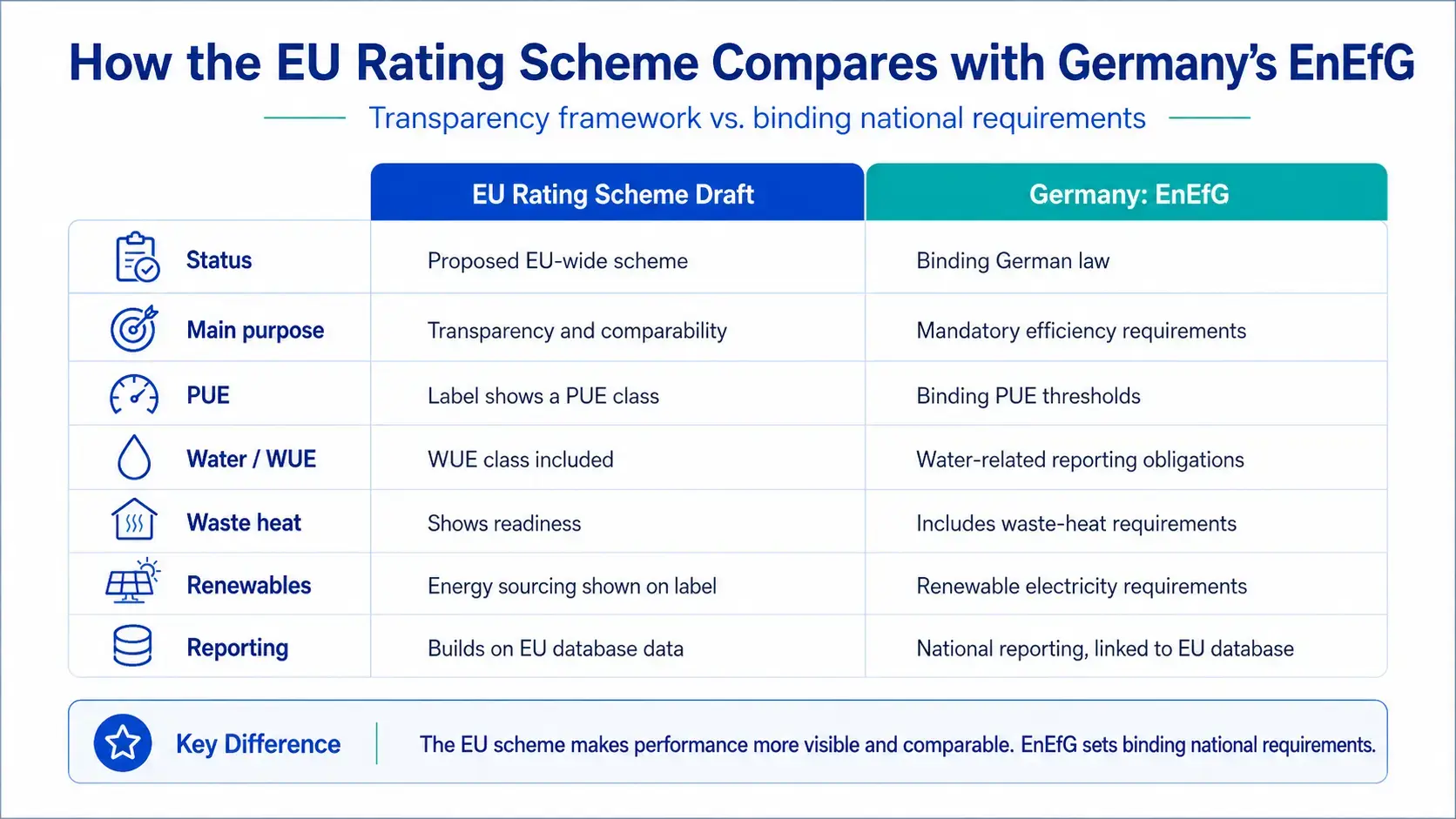
The important distinction is that the EU scheme focuses on visibility and comparability, while the EnEfG establishes binding requirements for operators in Germany.
Why the EU Rating Methodology Goes Beyond PUE
PUE remains one of the most important indicators for data centre efficiency. The proposed label would give it a prominent role. However, the draft also reflects a broader understanding: data centre performance cannot be evaluated fairly through a single metric alone.
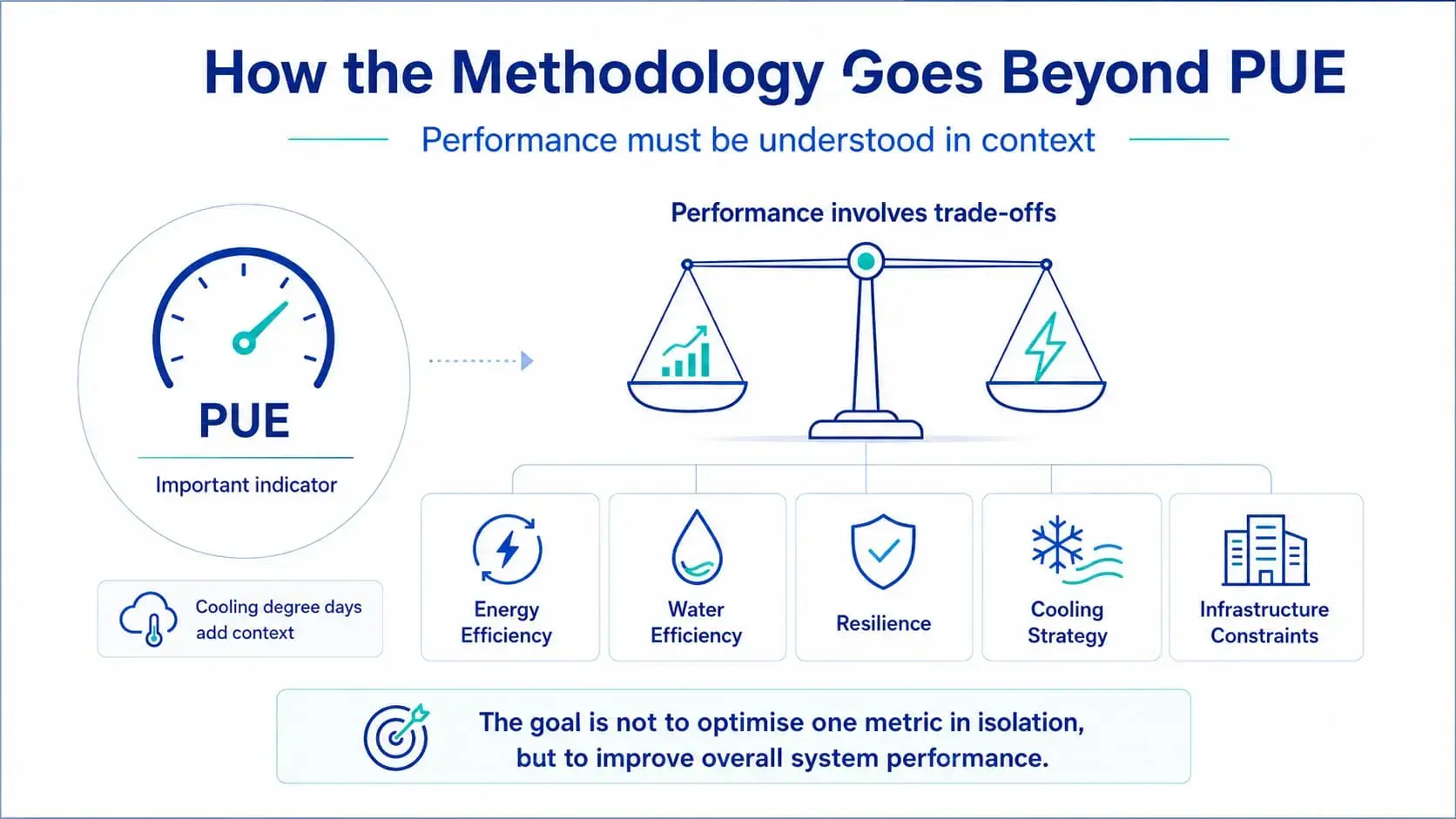
Data centre sustainability methodology showing how PUE performance must be considered alongside energy efficiency, water efficiency, resilience, cooling strategy and infrastructure constraints. Climate conditions, facility age, design constraints, and operational requirements can all influence performance. The proposed scheme therefore also considers additional context, including cooling degree days and other site-specific information.
Operators increasingly need to balance:
- energy efficiency
- water efficiency
- resilience
- cooling strategy
- renewable integration
- infrastructure constraints
The stronger the understanding of these interactions, the more meaningful individual performance indicators become.
PUE and WUE: Water Efficiency Moves Into Focus
One of the clearest signals in the proposal is that water efficiency is becoming more visible. For years, PUE has dominated discussions around data centre efficiency. The proposed scheme would place WUE alongside it as another visible performance indicator.
That matters because cooling decisions can affect both electricity and water consumption. A strategy that improves energy efficiency may have implications for water demand, while measures designed to reduce water consumption may influence energy use or operational conditions. For operators, this reinforces the need to assess cooling systems holistically rather than optimising PUE or WUE independently. The right question is not simply “How do we improve one KPI?” It is:
“How do we improve overall system performance without compromising resilience?”
Grid Flexibility Becomes More Relevant
Another notable element of the proposed rating scheme is the inclusion of electrical grid functions. Data centres are increasingly part of a wider energy system discussion. As electricity demand grows and more renewable generation enters European grids, attention is shifting from how much energy facilities consume to how intelligently some loads can interact with the wider system.
The proposed label would therefore indicate whether a data centre provides grid-supporting functions. This does not mean every site should participate in flexibility services. Technical requirements, operational risks, contractual arrangements and local conditions vary considerably. But it does raise a broader strategic question: Is the energy strategy focused only on reducing consumption or also on understanding how the facility interacts with the energy system around it?
Waste Heat Reuse Moves From Concept to Visible Readiness
Waste heat reuse follows a similar pattern. The proposed rating scheme would indicate whether a data centre is waste heat reuse ready. That distinction is important. Whether waste heat can actually be reused depends on factors that often extend beyond the facility itself, including nearby heat demand, infrastructure, distance to potential users, and economic feasibility.
The proposed label therefore focuses on readiness: whether a facility has been designed or retrofitted in a way that makes external waste heat use technically possible. For operators, this means that the technical conditions for future heat integration could become part of how a site’s sustainability performance is understood.
What Data Centre Operators Should Do Now
The proposed EU data centre regulation is still a draft. Operators therefore do not need to treat every detail as a final legal requirement. But there are several no-regret steps that already make sense.
1. Review Data Quality and Reporting Readiness
If future labels depend on reported data, the quality of that data becomes increasingly important. Operators should review whether their measurement, validation, and reporting processes provide a reliable picture of actual facility performance.
That includes asking:
- Is the relevant operational data available?
- Is it reliable and consistent?
- Are measurement points clearly understood?
- Can reported values be traced back to their underlying data?
- Are different systems using consistent definitions and boundaries?
Better data is valuable regardless of the final design of the rating scheme.
2. Look Beyond PUE Alone
PUE remains important, but it is increasingly only one part of the performance picture. Operators should understand how their cooling strategy, water use, renewable energy sourcing, and infrastructure design interact. That means looking beyond individual KPIs and understanding the system-level trade-offs behind them.
3. Identify No-Regret Optimisation Opportunities
Operational improvements that reduce energy demand, improve cooling performance, or strengthen monitoring capabilities are likely to remain valuable regardless of the final wording of the regulation.
Potential areas include:
- cooling setpoint optimisation
- better coordination of cooling equipment
- identifying inefficient operating modes
- improving airflow and cooling distribution
- detecting sensor or control-system anomalies
- improving visibility into operational energy flows
For existing facilities in particular, improving performance often means getting more out of infrastructure that is already installed.
4. Assess Grid and Heat Integration Potential
Operators should also understand whether their facilities have realistic opportunities to interact more effectively with the surrounding energy system. That could include assessing the following:
- potential for demand flexibility
- technical ability to provide grid-supporting functions
- availability of waste heat
- technical readiness for external heat reuse
- infrastructure constraints that could limit future integration
Not every opportunity will be viable at every site. Understanding the potential early nevertheless makes future decisions easier.
5. Prepare for Greater External Visibility
If sustainability labels become public, performance could become easier for customers, partners, policymakers, and procurement teams to compare. Operators should therefore understand not only what their KPIs are, but also why they are at their current level. A credible performance narrative should be able to explain the following:
- facility-specific constraints
- climate and cooling conditions
- relevant design decisions
- improvement measures already implemented
- the roadmap for further optimisation
The objective should not be to optimise the label itself. It should be to improve the operational performance represented by it.
How Operational Intelligence Can Improve the Performance Behind the Numbers
From an etalytics perspective, the proposed rating scheme reinforces a broader development in data centre operations. Better reporting creates transparency. But reporting alone does not improve performance. That requires better operational decisions. Digital twins, advanced analytics and data-driven optimisation can help operators understand how cooling and energy systems behave under changing IT loads, environmental conditions and infrastructure constraints.
Instead of looking at individual components or KPIs separately, Operational Intelligence can connect data across the energy system, identify the reasons behind inefficient operation and determine where optimisation is possible. That distinction becomes increasingly important as sustainability metrics become more visible. Reporting can show that performance has changed. Operational Intelligence can help explain why it changed and what to do next. For high-performing facilities, the differentiator will therefore not simply be the quality of reporting. It will be the quality of the operational decisions behind it.
What Comes Next for the EU Data Centre Rating Scheme?
The EU Data Centre Rating Scheme Draft is more than a labelling proposal. It is a signal of how data centre sustainability policy is evolving in Europe. The final requirements may still change before the regulation is adopted. But the direction is already clear. Data centre sustainability is becoming:
- more transparent
- more comparable
- more operationally relevant
- more connected to broader energy-system goals
For operators, the right response is not to optimise for a future label. It is to understand and continuously improve the performance behind it. Because better reporting makes performance visible. Better operations make it better.