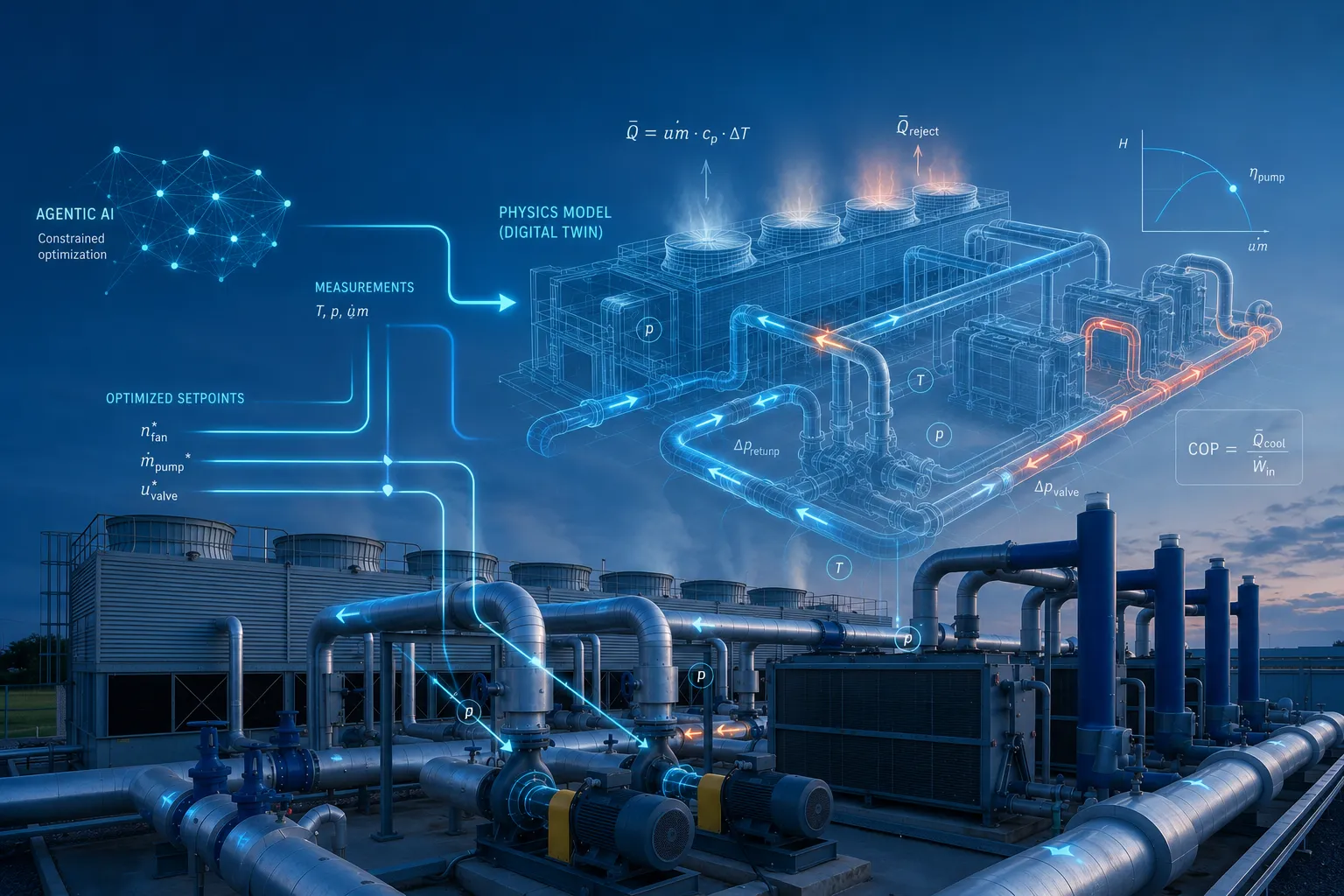
How bounded AI agents can help cooling teams diagnose problems, evaluate responses and act safely without giving up control
A cooling tower is still meeting demand, but its performance has been drifting for several days.
There is no critical alarm. Supply temperatures remain within limits. From the control room, the facility looks stable.
The weather forecast, however, shows a period of high ambient temperatures approaching. If the performance loss continues, the cooling plant may have less reserve than the operating team expects.
Today, an engineer investigates the issue by comparing approach temperatures, fan speeds, water flow, valve positions, heat-exchanger performance, weather conditions and the behavior of similar cooling towers. Based on that evidence, they determine whether the cause is fouling, a faulty measurement, an operating setpoint or a genuine change in load.
The same operating logic applies to other cooling architectures, including declining dry-cooler performance, missed economizer opportunities, low delta-T in chilled-water systems or unexpected behavior in coolant distribution units.
This is exactly the type of operational challenge where agentic AI delivers value.
Not because an AI model should be given unrestricted control of the cooling plant, but because several bounded AI agents work together to turn an emerging issue into a tested, explainable and verifiable response.
That is what agentic AI means for data center operations.
Agentic AI is more than a chatbot for the BMS
Natural-language access to operational data is useful.
An operator may want to ask why cooling energy increased, which asset is limiting capacity or whether free cooling is being used whenever conditions allow. An AI assistant can make that information easier to find and understand.
But answering a question is not the same as managing an operational workflow.
A genuinely agentic system works toward a defined objective. It selects from approved capabilities, gathers the required evidence, evaluates possible actions and determines what should happen next.
In a data center, that should not mean one general-purpose model making every decision. The safer and more practical architecture is a group of specialized agents with restricted responsibilities.
A useful distinction is:
Agents coordinate decisions. Skills perform bounded engineering work.
An agent investigates declining cooling-tower performance. The skills include validating a sensor, comparing similar assets, calculating expected performance, running a digital-twin simulation or producing an operator recommendation.
Each skill has a defined purpose, input, output and permission level. The agent can select and coordinate those skills, but it cannot act outside the boundaries approved by the operator.
That separation is what makes the system testable, governable, and suitable for critical infrastructure.
What an agentic cooling workflow looks like for leading operators
Leading data centers are already combining digital twins, predictive analytics and AI-assisted decision support to improve cooling operations. An agentic workflow builds on these proven capabilities by coordinating them through bounded AI agents.
Returning to the cooling-tower example, an agentic response does not begin by changing a setpoint. It begins by establishing whether there is enough evidence to act.
1. Validate the operating data
A data-quality agent checks the relevant measurements.
It compares the cooling-tower inlet and outlet temperatures, flow measurements, fan commands and ambient conditions. It looks for missing data, implausible changes and inconsistencies between related sensors.
If the evidence suggests that the apparent performance loss is caused by a drifting temperature sensor, the workflow should stop there. The next correct step is sensor inspection, not cooling optimization.
This is an important principle: the system must be able to conclude that it does not yet know enough.
2. Diagnose the likely cause
If the data is reliable, a diagnostic agent compares actual tower performance with the expected physical behavior.
It compares the affected tower with similar units under equivalent conditions. If one unit requires materially more fan power to deliver the same heat rejection, the system has stronger evidence of degradation.
The output is more than an anomaly score.
The operator needs an assessment that explains:
- what changed,
- when the change began,
- which causes are most plausible,
- what evidence supports them,
- and how confident the system is.
This is where AI becomes more useful than another alarm. It provides operational context.
3. Anticipate the consequence
The next agent looks forward.
Using the weather forecast, expected IT load and current cooling-plant condition, it evaluates whether the tower degradation is likely to create a capacity or efficiency problem during the coming hot period.
The facility may have enough cooling capacity today. That does not mean it will have enough capacity three days from now.
The forecasting agent therefore asks a more valuable question:
If nothing changes, where will the system be operating when conditions become more demanding?
This shifts the workflow from fault detection to operational foresight.
4. Test the available responses
A simulation agent evaluates possible responses in the physics-based digital twin.
The options might include adjusting tower sequencing, changing fan operation, modifying cooling-water temperatures or scheduling maintenance before the high-temperature period begins.
Each option has trade-offs. Increasing fan speed may restore thermal margin but consume more electricity. Bringing an additional tower online may improve heat rejection while increasing pump demand. Changing a water-temperature target may affect chiller performance elsewhere in the plant.
The digital twin provides a safe environment for comparing these options before they affect the live facility.
The objective is not to optimize one component. It is to identify the response that produces the best result across the complete cooling system.
The safety agent should have the power to say no
Once a preferred strategy has been identified, a safety or reliability agent evaluates it against the facility’s operational rules.
This includes checking:
- temperature and pressure limits,
- minimum cooling reserve,
- equipment availability,
- control permissions,
- model applicability,
- conflicting commands,
- and defined fallback conditions.
If the proposed action falls outside a validated operating range, it should not proceed.
If confidence is too low, the system should request operator input.
If a critical measurement is unavailable, the recommendation should be withheld.
In critical infrastructure, visible uncertainty is part of responsible operation.
In critical infrastructure, an agent that can withhold a recommendation is safer than one designed to always produce an answer.
Operators decide how the action is executed
Once a proposal passes the relevant checks, the operator receives a concise explanation:
- What is expected to happen
- What is causing the issue
- Which action is recommended
- What the expected effect will be
- Which constraints have been checked
- How confident the system is
- Whether operator approval is required
The same workflow can support different levels of autonomy.
At one site, the system may only provide a recommendation. At another, it may prepare a setpoint change that requires confirmation. A validated, lower-risk workflow may eventually run automatically within a tightly defined operating envelope.
The objective is to use the right level of autonomy for each decision.
This matters because operators remain cautious about giving AI direct control of mission-critical infrastructure. Uptime Institute’s 2025 survey found greater acceptance of AI for sensor analytics and predictive maintenance than for changing equipment setpoints or configurations. (Uptime Institute Global Data Center Survey 2025)
Agentic operations therefore need to build trust through evidence, not through promises.
Verification closes the loop
The workflow is not complete when a recommendation is issued or a setpoint is changed.
A verification agent must compare the actual response with the expected result.
Did cooling-tower performance improve? Was the required thermal margin restored? Did total plant energy decrease, or was consumption shifted to another subsystem? Did the model predict the response accurately?
The answer determines what happens next.
If the strategy worked, the system can document the result and retain the operating knowledge for comparable conditions. If the response differed from the prediction, the model or diagnosis may need to be updated. If the facility approaches a defined limit, the system should return to the approved fallback strategy.
This creates a continuous operating loop:
Observe. Diagnose. Anticipate. Simulate. Validate. Act. Verify. Learn.
The value of agentic AI is not only that it can recommend an action. It is that it can remain accountable for what happened after the action was taken.
Start with one bounded workflow
Agentic operations do not need to begin with a facility-wide autonomous system.
The strongest first use cases are usually narrow enough to govern, but complex enough that continuous machine-supported analysis creates real value.
Examples could include:
- detecting and responding to declining cooling-tower performance,
- investigating missed free-cooling opportunities,
- identifying the cause of low delta-T,
- evaluating pump-pressure changes,
- or preparing the cooling system for a predicted peak-load condition.
Each workflow can be tested in read-only mode before any write access is enabled. Operators can review the evidence, compare recommendations with their own decisions and define the conditions under which the next level of automation becomes acceptable.
This is a practical path from AI assistance to agentic operations.
What exists today, and what comes next
The foundations of agentic operations already exist. Physics-based digital twins, system-level optimization, safe control integration and continuous verification are delivering measurable results in live facilities today.
The next evolution is coordinating these proven capabilities through bounded AI agents that determine which analytical, simulation or optimization capability is needed for a given situation, assemble the required operational context and guide the workflow from initial observation through verified outcome.
This is the operating model beginning to emerge in leading data centers. The competitive advantage no longer comes from deploying individual AI tools. It comes from orchestrating them into a coordinated operational workflow that helps operators make faster, safer and more informed decisions.
The result is not an unrestricted autonomous controller, nor another chatbot attached to the BMS. Instead, it is a coordinated team of digital specialists, each with a defined responsibility, trusted engineering skills and clear operational boundaries, working alongside the people responsible for the facility.
For data center operators, that is what agentic AI means. For everyone else, it is the direction the industry is heading.

A free etalytics feasibility study can assess your cooling infrastructure, operational data and control environment to identify the first bounded workflows where AI-driven Operational Intelligence could create measurable value.