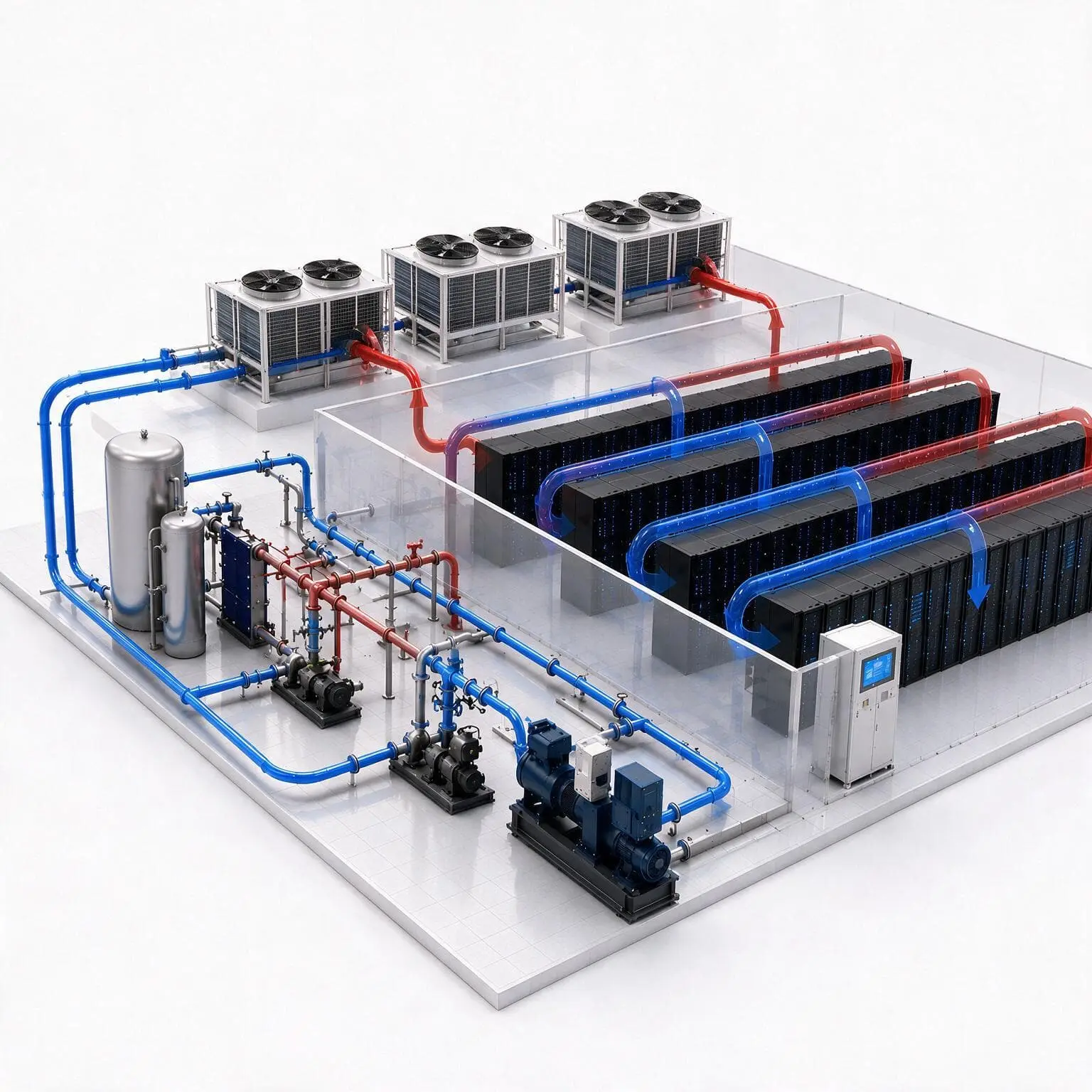
Modernizing an industrial cooling system is rarely as simple as replacing a single component. Pumps, chillers, cooling towers, and control strategies interact in ways that can significantly influence overall system performance. An industrial cooling system retrofit that appears promising at component level may deliver very different results once implemented across the entire system. This is where optimization-enabled simulation provides a more reliable basis for decision-making. By combining operational data, digital twins, and scenario-based simulation, operators can evaluate retrofit options before investing, compare technical and economic performance under identical operating conditions, and identify the solutions that deliver the greatest long-term value.
Three key takeaways
1. Retrofit decisions should be evaluated at system level, not component level.
Changing one component in an industrial cooling system can shift operating points, constraints, interactions, and control behavior across the entire system.
2. Scenario-based simulation creates a fair comparison between today’s system and future configurations.
By evaluating all retrofit variants under the same historical boundary conditions, operators can compare baseline and modified systems more reliably.
3. The best retrofit option is not always the one with the highest energy savings.
This is one of the most important insights for retrofit decision-making. A scenario can deliver strong energy savings but still be difficult to justify if the required investment is too high, the payback period is too long, or the implementation risk is too great. A strong recommendation must therefore combine technical performance with economic feasibility, including investment cost, operational savings, payback period, net present value (NPV), and Internal Rate of Return (IRR).
Introduction
Industrial cooling systems are complex, dynamic energy systems. They supply production processes, machinery, cleanrooms, or data centers with reliable cooling while balancing several competing requirements: high availability, stable temperatures, low energy costs, and reduced CO₂ emissions. At the same time, many operators face a strategic question: How can an existing cooling system be modernized in a way that is both technically effective and economically justified?
Is it worth replacing a pump? Would adding thermal storage create measurable benefits? Could a variable frequency drive pump reduce energy consumption? Or would a retrofit improve one component while unintentionally shifting the operating behavior of the entire system?
This is the challenge addressed in the master’s thesis of Bhavya Patel at Hochschule Ansbach, titled Development of an Optimization Enabled Framework for Scenario-Based Simulation of Industrial Cooling Systems. The thesis develops a structured approach for evaluating retrofit options in industrial cooling systems.
The central idea is simple but powerful: optimization should not only focus on the existing system configuration. It should also support the evaluation of future or modified configurations before they are implemented.
In other words, the framework asks: What happens if we change X in the system?
From intuition to data-driven retrofit decisions
In practice, modernization decisions are often based on experience, supplier information, or isolated component-level calculations. While this is understandable, it can be insufficient for complex cooling systems. The impact of a retrofit is rarely limited to the modified component. For example, replacing a fixed-speed pump with a speed-controlled pump does not only affect the pump’s own electricity consumption. It can also change hydraulic behavior, temperature differences, control strategies, operating points, and interactions with other components. This is why retrofit evaluation requires a system-level view.
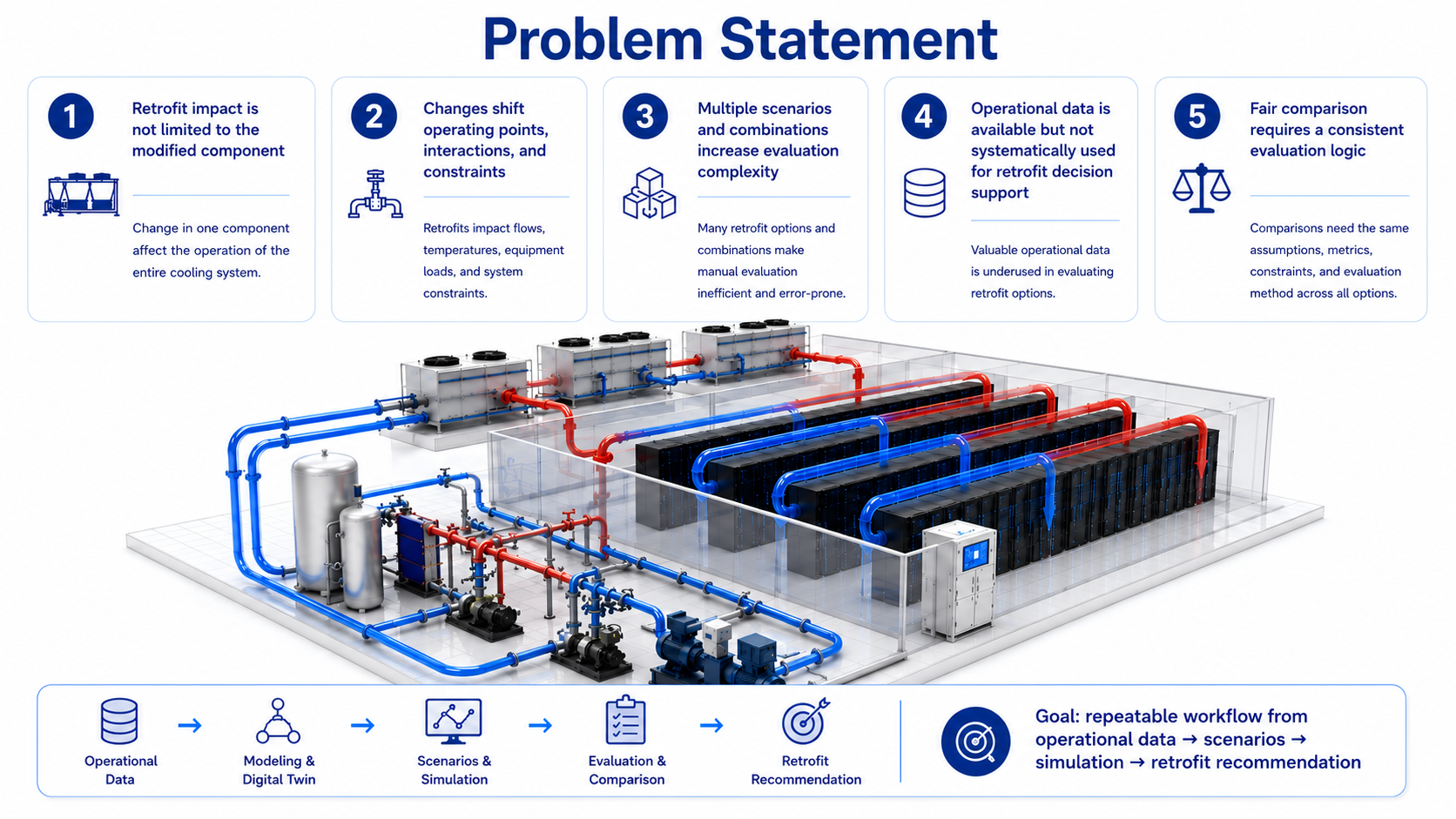
The complexity increases further when multiple retrofit options are available. Operators may need to compare several alternatives, evaluate combinations, understand technical dependencies, and assess economic feasibility. A structured decision process is therefore needed - one that connects operational data, digital models, optimization enabled simulation, and financial evaluation.
The thesis proposes a repeatable workflow that transforms operational data into retrofit scenarios, evaluates their impact through optimization-enabled simulation, and translates the results into technical and economic recommendations.
The six-step framework at a glance
The developed workflow follows a clear logic: operational data is used to identify relevant retrofit scenarios, scenarios are checked for compatibility, models are adapted and calibrated, simulations are run under identical conditions, and the results are evaluated technically and economically.
1. Data preparation and scenario generation
The first step prepares the system context and operational data. Relevant features and Key Performance Indicators are extracted from historical data, such as operating hours, component energy shares, load patterns, electricity tariff variations, and system behavior under different boundary conditions. Based on this analysis, the framework detects patterns and links them to a scenario template library.
For example, if a fixed-speed pump shows high operating hours and a high share of energy consumption, this may trigger a pump-related retrofit scenario such as adding a variable frequency drive or replacing the pump with a VFD pump. If significant differences between peak and off-peak electricity tariffs are identified, a thermal storage scenario may be generated, such as adding 50 m³ or 100 m³ of storage capacity.
The generated scenarios are then scored and initially ranked. Criteria can include expected impact, cost, data availability, modeling complexity, and implementation complexity. This helps identify the most promising scenarios before detailed simulation work begins.
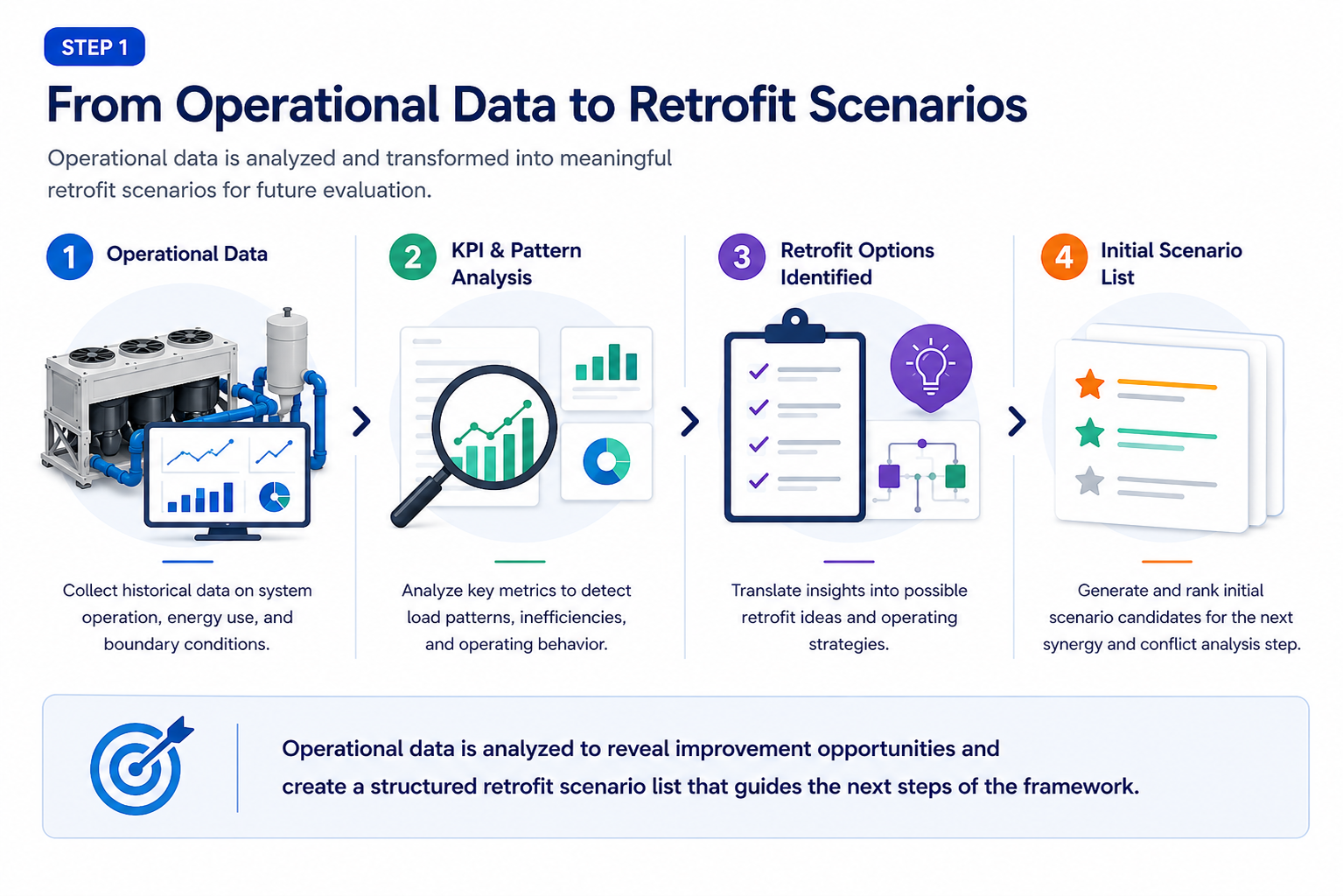
Industrial cooling system retrofit workflow showing how operational data is analyzed to generate and rank retrofit scenarios through KPI analysis and opportunity identification.
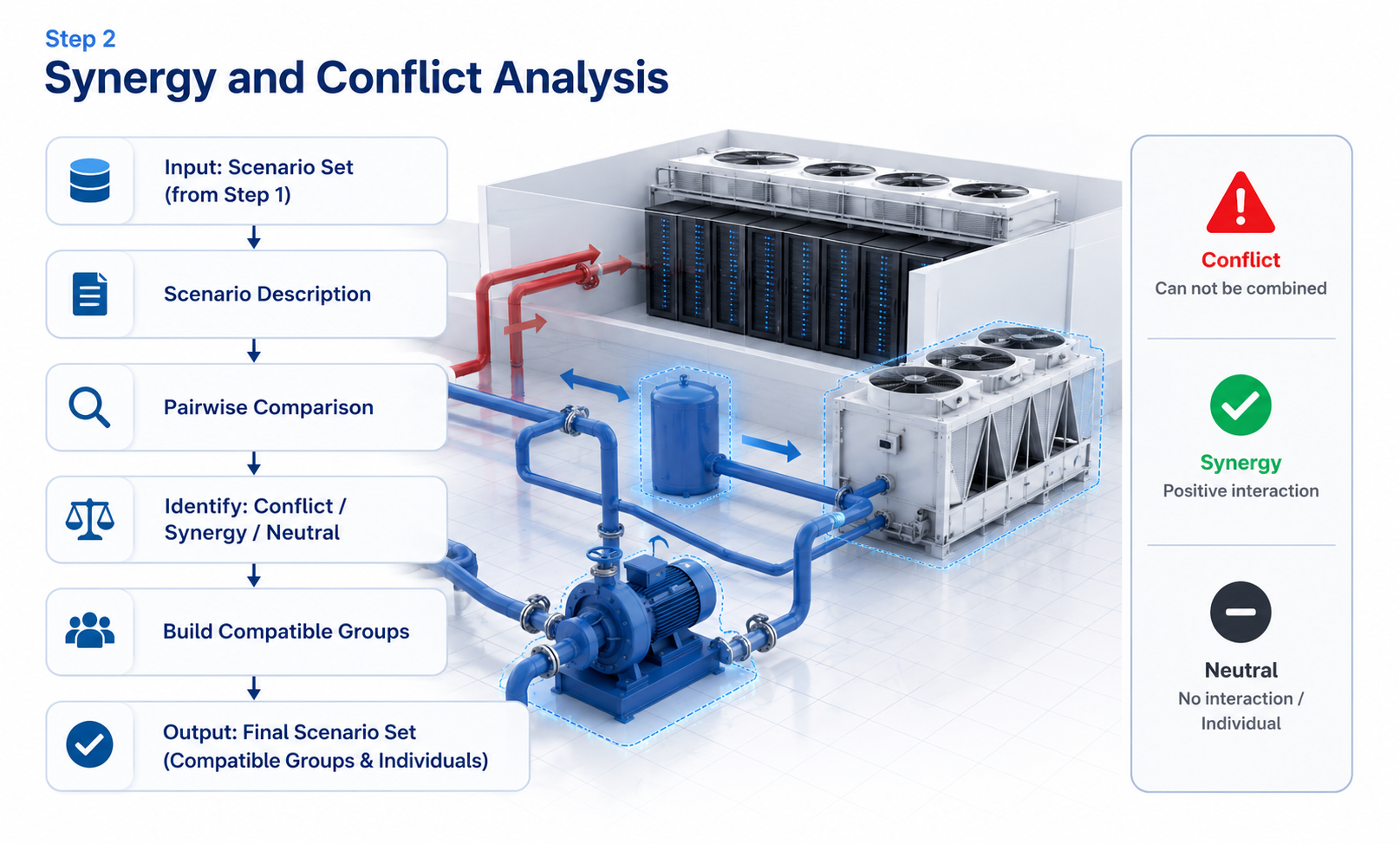
2. Synergy and conflict analysis
The second step evaluates whether the generated scenarios can be combined. Not every retrofit measure is compatible with every other measure. Some options may conflict with each other. Others may create synergies. Some may be neutral and can be evaluated independently.
The framework therefore performs a pairwise comparison of the scenario set and classifies relationships as conflict, synergy, or neutral. Based on this analysis, compatible scenario groups are created.
This step is important because real-world retrofit decisions often involve combinations of measures rather than one isolated intervention. A pump upgrade, thermal storage integration, and a modified control strategy may interact in ways that affect the final result.
3. System modeling and parameter estimation
The third step creates the modeling foundation for the simulation. The existing reference digital twin is preserved and cloned into a simulation testbench. This ensures that the original baseline model remains unchanged and can serve as a consistent benchmark for all scenario evaluations.
For existing components, parameters are estimated primarily from historical operational data. Real measured behavior is essential for meaningful retrofit analysis. If data is missing for specific components, manufacturer datasheets or reference datasets can supplement the estimation for that component only. For new retrofit components, manufacturer data or reference datasets are typically used.
A key principle is that boundary conditions remain identical across all simulations. Load profiles, ambient temperature, humidity, and other external influences are fixed for all scenarios. This enables a fair comparison between the baseline and each retrofit configuration.
4. Simulation of scenario configurations
In the fourth step, the framework simulates the baseline system and all retrofit configurations. First, the baseline model is validated by comparing simulated electrical power consumption with measured electrical power consumption. This validation confirms whether the digital twin reproduces the real system behavior with sufficient accuracy before it is used for scenario evaluation.
Once validated, the baseline system is simulated in optimization mode. This is an important distinction: retrofit scenarios should not only be compared against an unoptimized current state. If the existing system already has optimization potential, this optimized baseline must be considered. Otherwise, savings could be incorrectly attributed to the retrofit, even though part of the improvement may come from better control.
Each retrofit variant is then simulated with an appropriate optimization strategy. Depending on the scenario, the strategy may reuse the baseline optimization approach or require a modified version. The results of the optimized baseline and all retrofit scenarios are stored for post-processing and comparison.
5. Comparison, visualization, and performance evaluation
The fifth step turns simulation results into technical insights. The analysis compares total electrical power consumption across the baseline and all retrofit scenarios. It also visualizes the relevant boundary conditions, such as thermal demand, ambient temperature, and humidity, to explain why certain scenarios perform better under specific operating conditions.
A component-level analysis helps identify which parts of the system are responsible for the energy differences between scenarios. This is important because total savings alone do not explain where the improvement comes from.
The framework also calculates absolute and relative performance indicators, such as energy savings in kWh and percentage savings compared with the baseline.
The output of this step is a technical ranking of all retrofit scenarios. This ranking identifies the strongest candidates from an energy-performance perspective and prepares them for economic evaluation.
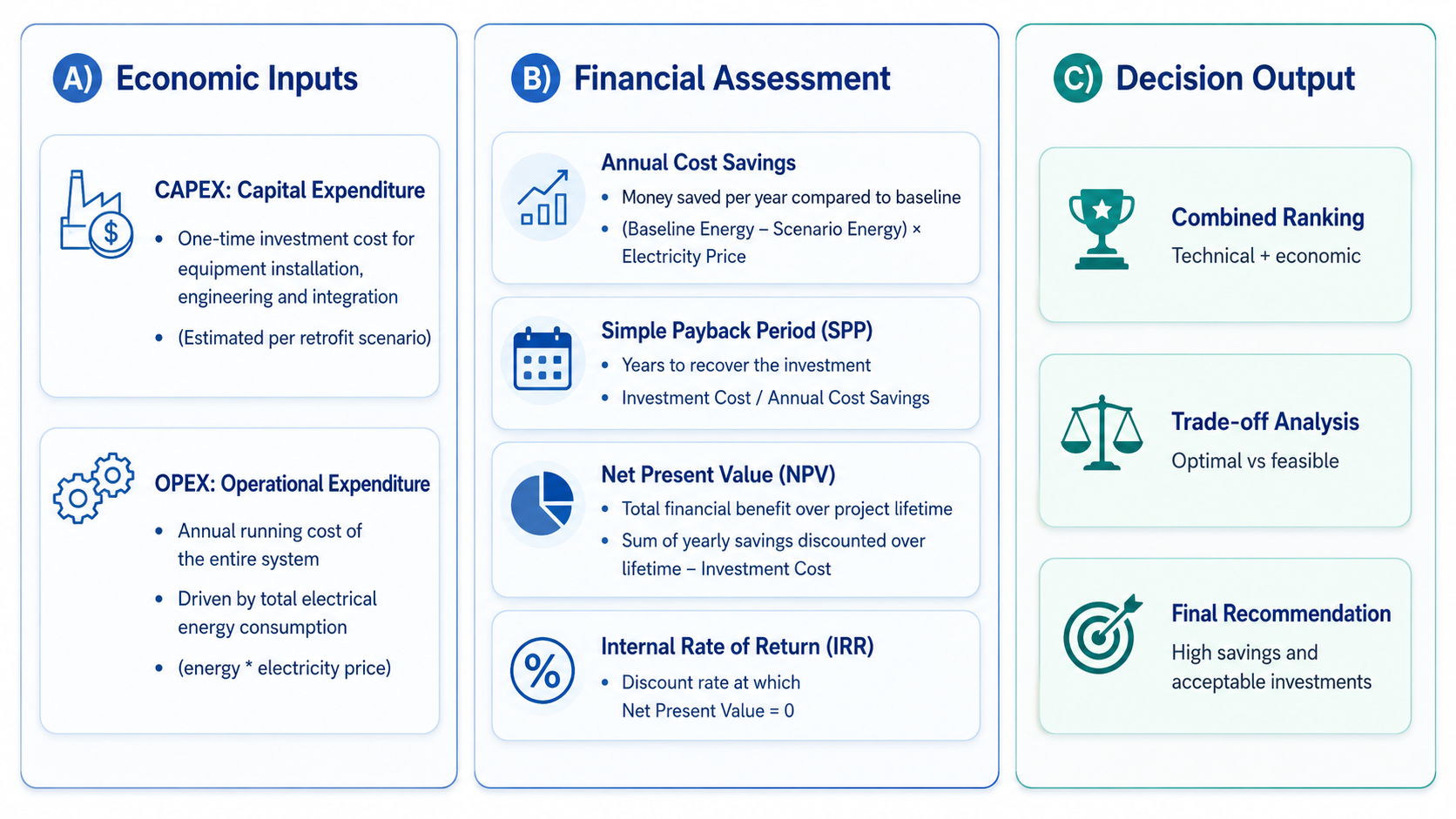
6. Economic evaluation and final recommendation
The final step combines technical performance with economic feasibility. Relevant inputs include capital expenditure, operational expenditure, electricity price, project lifetime, and financial assumptions. The assessment can include annual cost savings, simple payback period, net present value, and internal rate of return.
Annual cost savings are calculated based on the difference between baseline energy consumption and scenario energy consumption, multiplied by the electricity price.
The simple payback period shows how many years are needed to recover the investment. Net present value estimates the total financial benefit over the project lifetime after discounting future savings. The Internal Rate of Return indicates the discount rate at which the net present value becomes zero.
The final output is a combined technical and economic ranking. This allows decision-makers to evaluate trade-offs between maximum energy savings and practical feasibility.
The most energy-efficient scenario is not automatically the best investment. A technically strong option may require high investment or introduce implementation complexity. Conversely, a scenario with slightly lower savings may be more attractive if it has lower cost, faster payback, or lower project risk.
Why this approach matters for operators
The value of the framework lies in its repeatability. Instead of evaluating retrofit options once and in isolation, operators can apply a structured process across different systems, scenarios, and data situations. Operational data is not only used to understand the past; it becomes a basis for evaluating future system configurations.
For operators of industrial cooling systems, this creates greater transparency in investment planning. They can better understand which measures are technically promising, which combinations are feasible, and what effects can be expected under realistic operating conditions.
The approach also reduces the risk of making investment decisions based on simplified assumptions. This is especially relevant for systems with high energy costs, dynamic load profiles, complex topologies, or strong interactions between components.
In such systems, a linear component-level view is rarely enough. Only the combination of digital twins, data-driven calibration, scenario simulation, optimization, and economic evaluation can show how a retrofit affects the overall system.
Conclusion: Better retrofit decisions with optimization-enabled scenario simulation
Bhavya Patel’s master’s thesis shows how industrial cooling systems can be evaluated not only for current operational optimization but also for future system modifications. This goes beyond traditional energy audits or component-level comparisons. It evaluates retrofit measures in the context of the entire system and makes their technical and economic effects comparable.
For companies aiming to reduce energy consumption, operating costs, and emissions, such a methodology can become an important decision-support tool. It helps make retrofit investments more targeted, more transparent, and more effective.