Book Demo
Book Demo


Prevent demand spikes and capacity violations with automated peak control
Shift and coordinate loads within operational, temperature, and redundancy limits
Turn peak response from reactive firefighting into repeatable system intelligence










Most sites still manage peak events manually, reacting too late or operating too conservatively to avoid risk. The result is unused flexibility, unnecessary demand charges, and infrastructure that operates below its actual potential. As power demand becomes more dynamic, peak-driven headroom increasingly limits growth, efficiency, and operational resilience. Traditional EMS platforms monitor demand. etalytics orchestrates flexibility.
.svg)
etalytics transforms peak management from manual intervention into continuous operational control.
Using live telemetry, configurable control logic, and real-time system coordination, the platform detects peak risk before thresholds are reached and orchestrates available flexibility across the site. Instead of optimizing individual assets in isolation, etalytics determines how the full energy system should behave to reduce peaks, preserve stability, and improve capacity utilization.
Typical optimization modules and use cases:

Detect peak risk before thresholds are reached, creating more time to intervene and fewer emergency decisions
Coordinate CHP, boilers, storage, cooling, and flexible loads as one system instead of separate assets
Move loads proactively based on demand forecasts, operating priorities, and site constraints
Use battery and thermal storage to buffer short-term spikes without disrupting operations
Coordinate HVAC and thermal systems with electricalinfrastructure, batteries, CHP, PV, and microgrids where relevant
Prioritize and shift EV charging and non-critical loads to preserve capacity for business-critical operations
Include onsite generation and flexible demand in peak control to reduce grid peaks and increase local energy use

Reduce total energy input and cost across the optimized scope.
Measured by normalized kWh or MWh consumption, energy cost in EUR or USD, and savings compared with an agreed baseline.
Reduce emissions by operating assets more efficiently and shifting operations where lower-carbon energy is available.
Measured by CO2e reduction over a defined period.
Reduce manual setpoint changes, overrides, and reactive troubleshooting.
Measured by manual intervention rate, override events, and operator time spent on recurring control adjustments.
Avoid unnecessary operation and prioritize efficient modes such as free cooling, optimized part-load operation, and coordinated asset use.
Measured by runtime hours, start-stop cycles, and utilization of active versus passive or more efficient modes.
Maintain temperatures, pressures, humidity, airflow, or other operating parameters within defined boundaries.
Measured by deviation from target ranges and percentage of time within operating limits.
Use thermal inertia, storage, on-site generation, and price signals where relevant.
Measured by shifted load, avoided peak demand, use of favorable tariffs, or demand response participation.
Quantify savings potential, technical fit, risk, and implementation effort before scaling.
Measured by expected savings versus solution cost and a clear rollout decision.
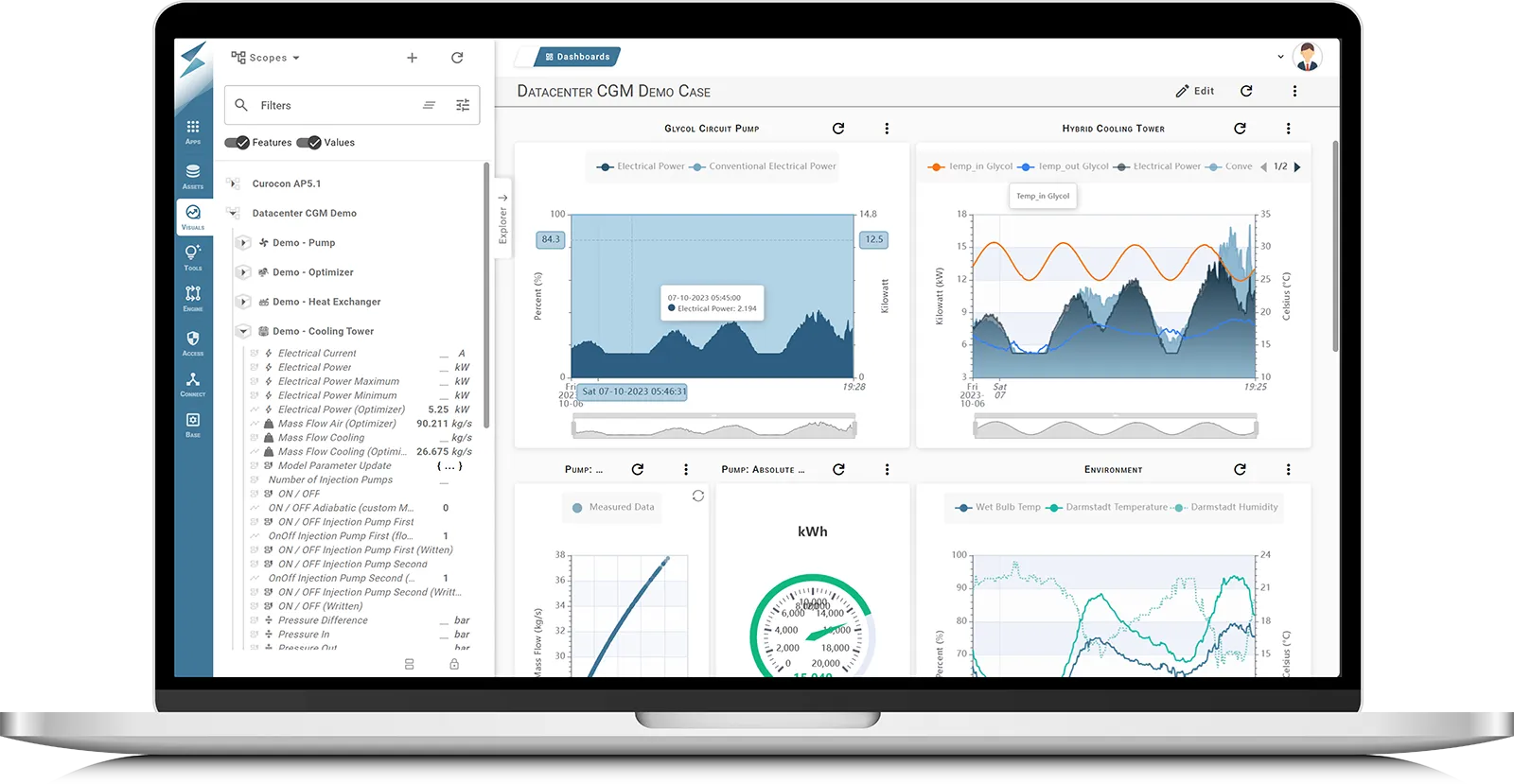
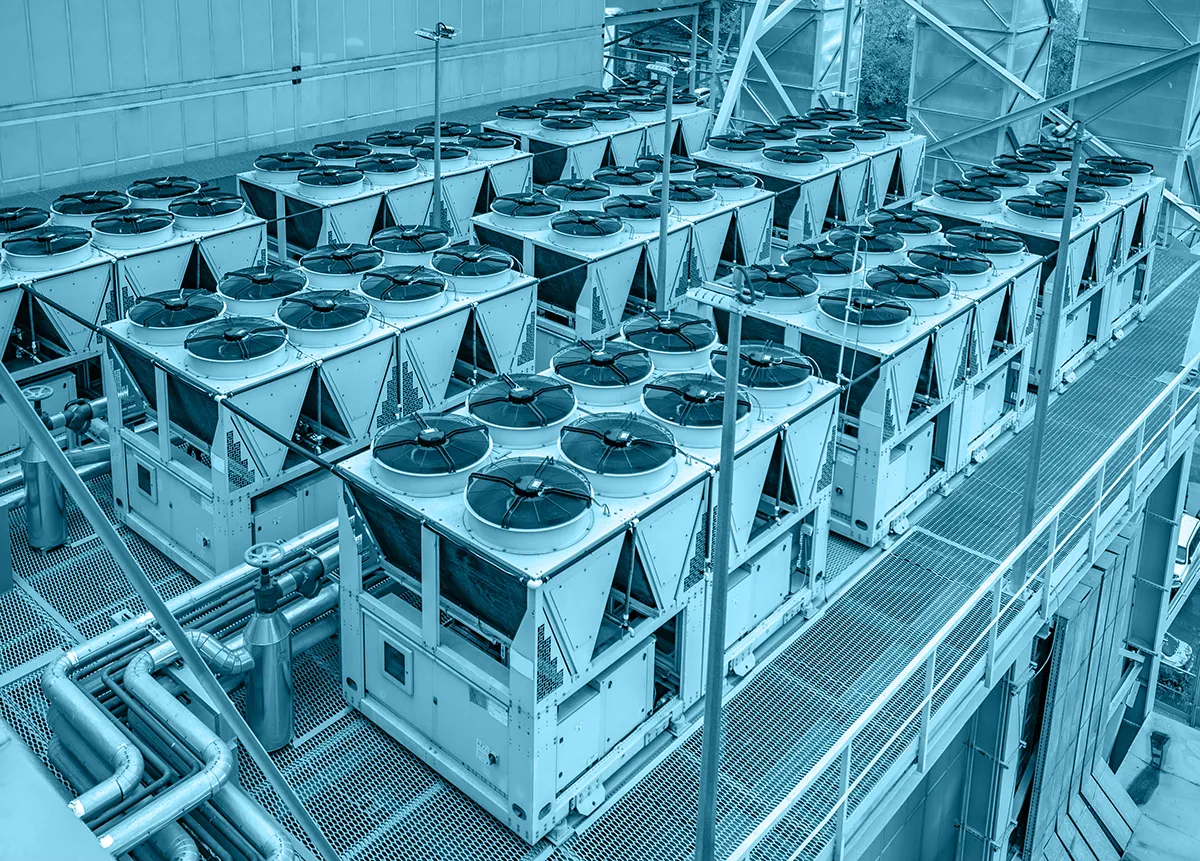
Optimize cooling plants, free cooling, hydraulic distribution, airflow-related dependencies, and supply temperatures while protecting mission-critical uptime and stability.
Improve HVAC and utility efficiency while maintaining stable environmental conditions, compliance requirements, and operational boundaries.
Coordinate cooling, heating, ventilation, thermal utilities, and electrical infrastructure under fluctuating production loads and changing energy prices.
Reduce energy waste in process cooling, ventilation, heating, and site-level energy systems with variable production schedules and operating modes.
Improve performance in complex HVAC environments where demand, occupancy, weather, and operating schedules change continuously.
etaONE® turns your operational data into a live digital twin of your energy system and uses AI to continuously identify the best operating strategy for your site. The result is lower energy cost, earlier detection of performance drift, and better operational decisions with less manual work – without replacing your existing infrastructure.

Built for real-world systems
We model your actual chillers, pumps, heat exchangers, and cooling assets – not a generic template.

Physics-based, data-trained
Our digital twin combines engineering logic with live operating data for reliable, site-specific optimization.

Actionable, not theoretical
We do not just report inefficiencies. We identify where performance drifts, what it means, and what to do next.

Safe by design
You decide the level of autonomy. From recommendation mode to closed-loop control, operators stay in charge.

Fast to implement
We connect to your existing BMS using standard protocols – no rip-and-replace required.

Proven in mission-critical environments
Trusted by leading operators in data centers and industry, with measurable impact on efficiency and operations.
Equinix, Merck, and others achieve up to 50% cooling energy savings with etalytics. Explore our case studies.
Request a feasibility study to evaluate real-time monitoring dashboards for your site. We assess connectivity, data readiness, and which KPIs and dashboards deliver the fastest impact on energy costs and operational efficiency.
Trusted by operators across data centers and industry





We empower industries to make complex energy systems and operations more intelligent, efficient, and resilient — with AI and digital twins that operators can trust.

















.webp)