Book Demo
Book Demo

The Energy Reuse Factor measures the share of externally reused waste heat in relation to a data center’s total energy consumption. The dimensionless metric ranges from 0 to 1 and focuses on external heat reuse with broader impacts on climate and urban energy systems.
Data centers are among the fastest-growing energy consumers worldwide. With the increasing demand for digital services, the requirements for their energy efficiency and sustainability are also rising. While classic key performance indicators (KPIs) such as Power Usage Effectiveness (PUE) have long been paramount, the utilization of waste heat is increasingly coming into focus. The Energy Reuse Factor (ERF) assesses how efficiently data centers reuse their waste heat off-site. This broadens the perspective on energy performance to include a circular economy approach. In times of growing demands from ESG guidelines and sustainability goals, the ERF is gaining importance as a strategic KPI.
The Energy Reuse Factor describes the ratio of externally utilized waste heat to the total energy consumption of a data center. For the first time, it enables a quantitative assessment of the actual amount of energy recovered for other applications – such as space heating or process heat supply. This dimensionless metric ERF ranges from 0 (no external reuse) to a theoretical maximum of 1 (all input energy reused externally), as reused energy cannot exceed total energy consumption due to conservation of energy principles. Unlike internal heat recovery—which improves PUE but excludes from ERF—external reuse drives broader impacts in climate strategies, urban heating networks, and industrial symbiosis.
The international standard ISO/IEC 30134-6 defines the ERF in a standardized way and ensures that the indicator is applicable and comparable across different frameworks. Within the EU, it is further integrated into sustainability guidelines and tendering processes via DIN EN 50600-4-6. These standards precisely define metrics, system boundaries, and application conditions. Thus, the ERF is increasingly becoming the recognized basis for reporting requirements, for example, within the framework of environmental reports, funding programs, or ESG ratings.
Data centers convert almost all of their electrical energy into heat. If this heat is released unused, valuable energy is lost. The ERF helps to visualize this loss and incorporate it into the overall energy efficiency assessment. Particularly in urban areas or industrial environments, data centers can make an active contribution to the energy supply by utilizing their waste heat – either by supplying heat to buildings or by coupling it with industrial processes.
Compared to Power Usage Effectiveness (PUE), which measures on-site efficiency (total facility energy / IT energy), ERF provides a complementary perspective by assessing external reuse value and returning energy to broader cycles. The Energy Reuse Effectiveness (ERE), developed by The Green Grid, builds on ERF by factoring in heat quality and efficiency: ERE = ERF × AARE (Annual Average Reuse Effectiveness, 0-1 scale adjusting for temperature match to end-use), making ERE more comprehensive yet methodologically complex for off-site applications.
Formula and measurements
The calculation is performed according to the official formula in ISO/IEC 30134-6:
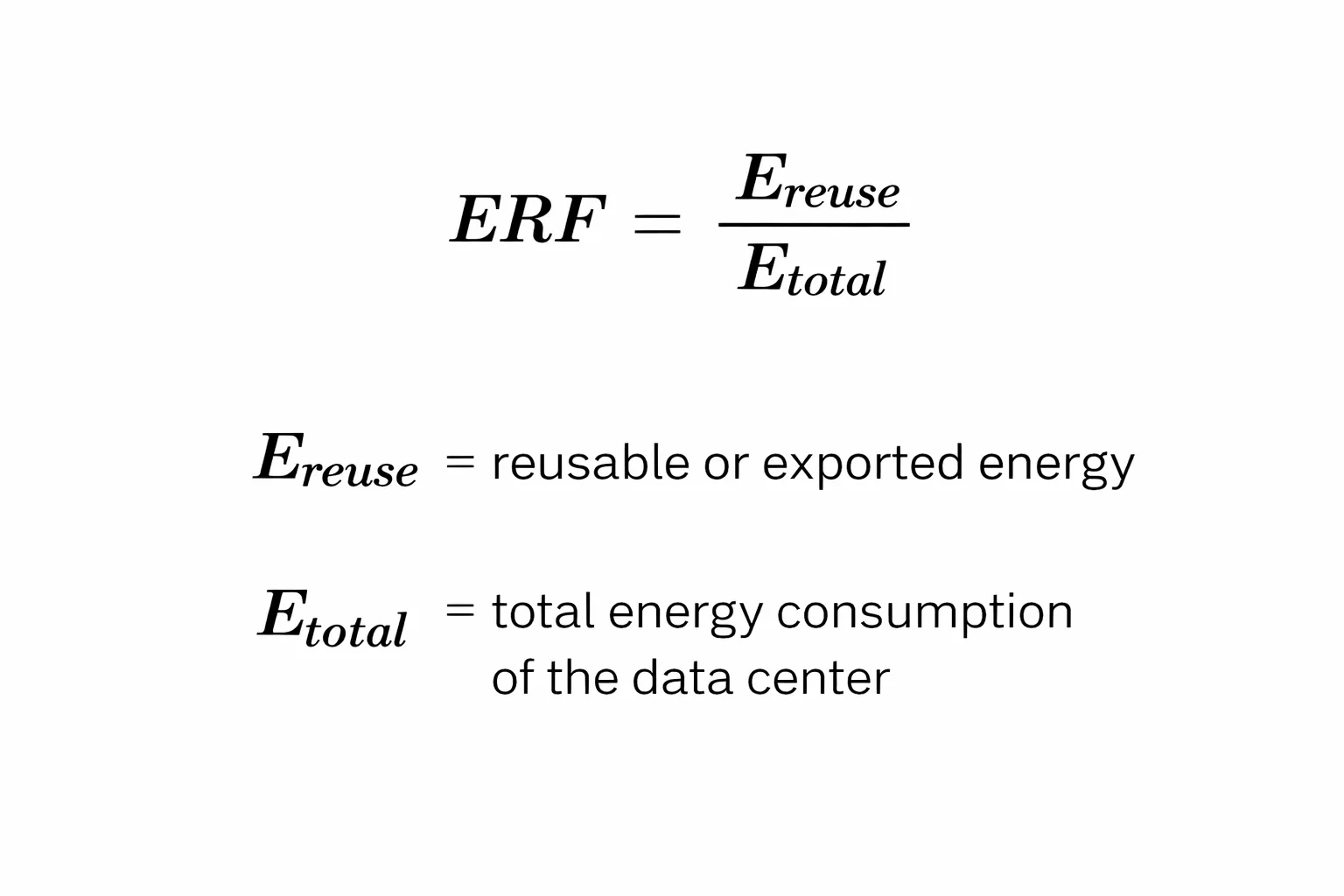
The ERF is dimensionless and ranges from 0 (no energy is reused externally) to 1 (all energy consumed is reused for beneficial purposes elsewhere), since reused energy cannot exceed the total energy input. Internal recirculation of heat – for example within cooling systems – is not included, to reflect the actual external impact and system-level efficiency. Accurate ERF calculation requires precise metering of energy flows, typically using calibrated thermal energy meters(combining flow and temperature measurements) and electrical energy meters integrated into an energy management system. In practice, the measurement of energy use (ERF) is often associated with uncertainties. Heat losses, fluctuating demand, or a lack of sensors can distort the measurement. Furthermore, ERF is highly dependent on the specific usage context. For better comparability, it is recommended to transparently document measurement periods, system boundaries, and technologies used in order to objectively interpret values between locations.
The German Energy Efficiency Act (EnEfG 2023) requires operators of large data centers to document their waste heat recovery concepts, but without an explicit requirement to report the Energy Recovery Factor (ERF). Nevertheless, the ERF can be an important quantitative supplement to the documentation. European frameworks such as the Energy Efficiency Directive (EED) and the Corporate Sustainability Reporting Directive (CSRD) are also increasingly emphasizing energy recirculation – here, the ERF can play a central role in ESG reporting. Environmental labels such as the Blue Angel for energy-efficient data centers (DE‑UZ 228) and frameworks such as LEED or the EU Code of Conduct on Data Centre Energy Efficiency consider waste‑heat reuse as a sustainability or best‑practice criterion. The ERF serves as a standardized metric for assessing the energy performance of such reuse within these schemes.
By distributing usable heat, operators can generate additional revenue or reduce investment costs through subsidies. At the same time, the environmental footprint improves significantly – especially when fossil fuel heat sources are replaced. The ERF-optimized design of a data center thus not only strengthens its environmental performance but can also increase economic benefits and regulatory acceptance.
Not every location is technically or economically suitable for heat recovery. A lack of consumers, low temperature levels, or inadequate infrastructure can hinder its use—especially in smaller or decentralized data centers. Since ERF is highly dependent on local conditions and measurement parameters, isolated comparisons are of limited use. Transparently defining system boundaries, time periods, and measurement methods is essential to avoid distortions. Furthermore, ERF does not replace a comprehensive energy efficiency assessment but rather complements it.
The Energy Reuse Factor (ERF) offers a new perspective on energy efficiency: It reveals how much of the energy used is actually reused beyond the data center. As a standardized metric, it is gaining increasing relevance in the context of sustainability strategies, ESG reporting, and technical planning.
When correctly interpreted and documented, the ERF becomes a powerful management tool – for operators as well as for regulatory, planning, and economic decisions. In conjunction with PUE, CO₂ intensity, and other key performance indicators, it provides a more complete picture of modern data center architectures in the age of sustainable digitalization.
Azura Consultancy. (2025). Energy Reuse Factor.
https://www.azuraconsultancy.com/energy-reuse-factor/
Sustainability Directory. (n.d.). Why is waste heat recovery considered sustainable practice?.
https://energy.sustainability-directory.com/question/why-is-waste-heat-recovery-considered-sustainable-practice/
Gröger, J., & Behrens, F. (2023). Development of an energy efficiency label for data centres: Contribution to the discussion for more transparency in the digital economy. Öko-Institut e.V.
https://www.oeko.de/fileadmin/oekodoc/Oeko-Institut_energy-efficiency-label-for-data-centres.pdf
International Organization for Standardization (ISO) & International Electrotechnical Commission (IEC). (2018). ISO/IEC 30134-6: Information technology — Data centres — Key performance indicators — Part 6: Energy Reuse Factor (ERF).
German Federal Environment Agency. (2023). The Blue Angel Award – Environmental Criteria for Data Centre Energy Consumption (DE-UZ 228) (Version 3).
European Commission / JRC. (n.d.). EU Code of Conduct on Data Centre Energy Efficiency.
NY Engineers. (2024). How to design high-performance HVAC systems for LEED certification.
EW21. (2022). WestfalenWärme: Nutzung von Rechenzentrumsabwärme für die Fernwärme in Dortmund.
DEW21. (n.d.). Fernwärme (district heating) – Wärme für Privatkunden.
Nlyte. (2025). Energy Reuse Factor: A Key Metric for Sustainable Data Center Operations.
SFS / Project EXIGENCE. (2021). The ERF Standard Improves Energy Efficiency of Data Centres.





We empower industries to make complex energy systems and operations more intelligent, efficient, and resilient — with AI and digital twins that operators can trust.
