Book Demo
Book Demo

Energy losses occur when supplied energy is not converted into useful output but is wasted through inefficiencies such as heat transfer, friction, leakage, electrical resistance, storage losses, or idle operation. In data centers and industrial facilities, reducing these losses requires system-level transparency, demand-based operation, efficient equipment use, minimized distribution and storage losses, and recovery of usable waste energy.
Energy losses are a major efficiency lever in data centers and industrial facilities. They increase energy consumption without creating additional useful output and often appear as heat that must again be removed by cooling systems.
In complex energy systems, losses are rarely caused by one isolated defect. They typically result from the interaction of components, energy carriers, control strategies, operating points, distribution networks, storage systems, and safety margins. Once the physical setup of an energy system is given, its efficiency is largely determined by the way it is operated. A system can therefore waste energy even when all components are technically functional.
Typical causes include conservative setpoints, inefficient part-load operation, unnecessary pressure reserves, idle operation, poor insulation, unused heat recovery potential, or the use of less efficient energy carriers and converters.
Energy losses are the share of supplied energy that does not reach the intended point of use as useful energy, but is lost during conversion, distribution, operation, or storage.
Energy losses are the parts of energy input that are wasted through inefficiencies before they become useful for cooling, heat, compressed air, or mechanical work.
Energy losses occur when part of the supplied energy is not converted into useful output, but dissipated through heat transfer, friction, leakage, electrical resistance, throttling, standby consumption, inefficient conversion, or storage losses.
From an energy flow perspective, energy losses are part of a broader efficiency problem: energy is wasted whenever more energy is supplied, converted, transported, stored, or conditioned than is required to deliver the intended output in the right quantity, at the right time, and at the required quality level.
This is especially relevant in data centers and industrial facilities because losses often have a double effect. They increase the direct electricity or fuel demand of the affected system and can add heat that must be removed by cooling systems. Electrical losses in UPS systems, power distribution, pumps, fans, or other infrastructure, for example, eventually contribute to the facility’s heat load.
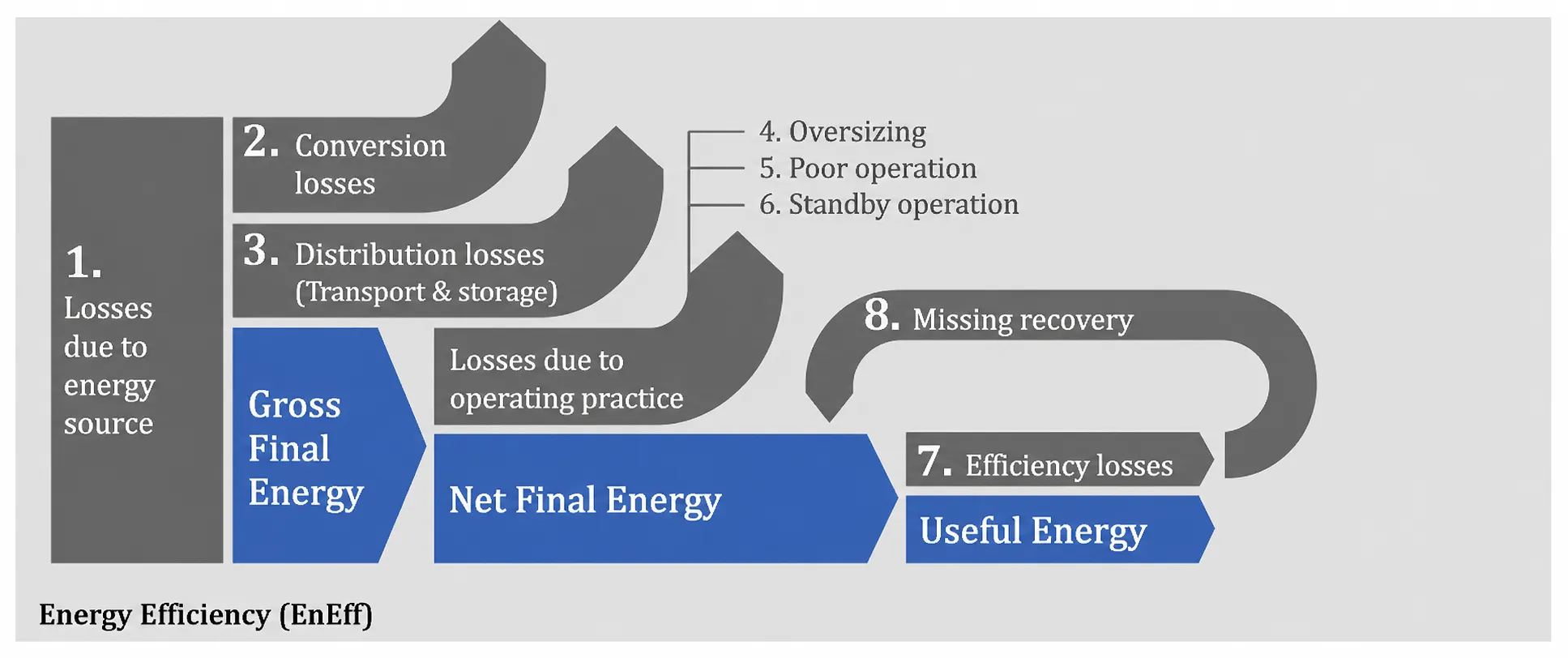
Energy efficiency improves when the same output is achieved with less energy input. In the context of energy losses, this means reducing unnecessary demand, avoiding inefficient operation, minimizing distribution and storage losses, using efficient energy carriers and converters, and recovering usable waste energy where possible.
Energy is usually supplied, converted, transported, distributed, controlled, stored, and finally used to provide an energy service such as cooling, heating, ventilation, compressed air, or mechanical work. At each stage, losses can occur. Some are physically unavoidable, while others are caused or amplified by operating strategies.
The following eight types of energy waste are especially relevant for understanding and reducing energy losses.
The same energy service can often be provided by different energy carriers. Heating, for example, can be generated with electricity, gas, waste heat, or a heat pump. From an efficiency perspective, the selected energy carrier should cause the lowest overall losses across the upstream and on-site energy chain.
If the energy carrier can be substituted dynamically during operation, the system should use the most efficient available option. In industrial facilities, this may mean using recovered heat or environmental energy before switching to higher-value energy carriers. In data centers, it may mean using free cooling whenever conditions and infrastructure allow it.
Energy converters such as chillers, compressors, pumps, fans, boilers, heat pumps, and motors differ in efficiency. In many facilities, several assets can provide the same energy service, but not all operate equally efficiently under the same conditions.
Losses occur when less efficient equipment is used although better alternatives are available. This is common in larger asset parks that include equipment from different generations. Efficient operation therefore requires asset prioritization based on actual efficiency, load conditions, and system constraints.
Local generation and environmental energy can reduce losses because energy is generated or captured close to where it is used. Examples include photovoltaic generation, ambient cooling, free cooling, geothermal energy, or waste heat use.
If locally available energy is not used although it could support the energy service, unnecessary losses may occur elsewhere. A data center may rely on mechanical cooling even during periods when outdoor conditions would allow more efficient heat rejection. Similarly, an industrial site may reject usable waste heat while generating heat elsewhere.
Most energy converters do not operate with constant efficiency. Their performance depends on part-load behavior, temperature levels, pressure levels, environmental conditions, and control settings.
Losses increase when assets are operated outside efficient ranges. A chiller with an unnecessarily low supply temperature, a pump running at excessive speed, or a compressor maintaining higher pressure than required may operate reliably but inefficiently. This type of loss is often hard to detect because the system appears stable while consuming more energy than necessary.
Energy is wasted when useful energy is provided above actual demand. This includes overcooling rooms, overheating buildings, supplying too much airflow, maintaining excessive pressure levels, or running systems at full capacity during low-load periods.
For energy efficiency, useful energy should be supplied only in the required amount, at the required time, and at the required quality level. In data centers, cooling must remain safe and reliable, but not unnecessarily conservative. In industrial facilities, utilities such as chilled water, compressed air, steam, hot water, and ventilation should be aligned with actual process demand.
Energy can be lost during storage, transport, and distribution. Thermal storage systems lose heat or cold over time. Pipes, ducts, and tanks can transfer energy to the environment. Fluid systems lose energy through friction, pressure drops, throttling, and leakage. Compressed air systems often lose significant amounts of energy through leaks.
Losses usually increase when high potential differences are maintained for long periods, such as high pressure, high temperature, or very low chilled water temperature. From an efficiency perspective, storage and distribution should therefore be minimized where they are not necessary, and idle parts of the system should be isolated or deactivated where possible.
Many systems consume energy even when they do not provide useful output. Pumps, fans, compressors, ventilation systems, auxiliary equipment, and control infrastructure may remain active during periods of low or no demand.
This is often accepted as normal operation because it does not cause immediate problems. Over long operating hours, however, standby and idle loads can become a significant source of energy waste.
Energy that leaves a system is not always worthless. Waste heat, condenser heat, compressor heat, process exhaust heat, or thermal energy from equipment may still be usable if the temperature level and demand profile match.
Energy is wasted when recoverable energy is rejected although it could supply another application. Low-temperature waste heat, for example, may be suitable for building heating, preheating, or local heating networks.
In real energy systems, energy usually passes through several stages before it becomes useful. It may be converted from electricity into cooling, transported through a chilled water network, controlled by pumps and valves, transferred through heat exchangers, and finally used to remove heat from a room, process, or data hall.
At each stage, part of the supplied energy can be lost. Some losses are unavoidable, but many are caused by operating decisions: running a pump faster than necessary, keeping a chiller supply temperature lower than required, operating assets in inefficient part-load combinations, or maintaining pressure in network branches that are not currently needed.
This is why energy losses should not only be treated as a component-level issue. A pump, chiller, valve, or heat exchanger may work exactly as designed while the system as a whole wastes energy because setpoints, schedules, asset sequencing, and control loops are not aligned with actual demand.
In complex cooling and energy systems, pumps, fans, chillers, valves, heat exchangers, recooling units, storage systems, and control loops continuously influence each other. If one part of the system operates with unnecessary safety margins or outside its efficient range, the resulting losses can affect the whole system.
This is where system-level optimization becomes important. etalytics uses digital twins and real-time operating data to understand these interactions and identify operating strategies that reduce total energy demand while respecting technical constraints.
Important types of energy losses include thermal, electrical, hydraulic, storage-related, operational, and conversion-related losses.
Thermal losses occur when heat or cold is transferred unintentionally through pipes, valves, tanks, ducts, or equipment surfaces. In chilled water systems, cooling energy may be lost before it reaches the consumer. In hot water or steam systems, useful heat may be released where it is not needed.
Waste heat is energy that leaves the system as hot exhaust air, hot fluids, condenser heat, compressor heat, or process heat. It is not always avoidable, but it may be recoverable if the temperature level and demand match.
Compressed air losses are caused by leaks, excessive pressure, inefficient compressor operation, or unnecessary compressed air use. Because compressed air is energy-intensive to generate, even small leaks can create significant waste over time.
Electrical losses occur in transformers, cables, motors, drives, UPS systems, PDUs, and other electrical components. In data centers, these losses are especially relevant because they usually appear as heat inside the facility.
Hydraulic losses include pressure losses, friction, throttling, and internal leakage in pumps, valves, pipes, and hydraulic systems. They often result from excessive flow, oversized safety margins, poor balancing, or inefficient pressure control.
Standby and idle loads describe energy consumed without productive output, for example by continuously running pumps, fans, ventilation systems, or auxiliary systems.
Storage losses occur during charging, discharging, or storing thermal or electrical energy. Thermal storage systems can lose heat or cold over time, especially when high temperature differences to the environment are maintained.
Efficiency describes the ratio of useful output energy to total input energy. Improving efficiency means increasing the useful share of energy input and reducing the share that is lost or wasted.
In data centers, energy losses affect both electrical infrastructure and cooling systems. Pumps, fans, chillers, UPS systems, PDUs, transformers, and power distribution networks all consume energy, and many losses ultimately become heat. This directly affects overall facility efficiency and PUE.
If cooling systems operate with unnecessary temperature lift, excessive airflow, high pump speeds, or conservative setpoints, they consume more electricity than required. At the same time, losses in electrical systems and auxiliary equipment increase the heat load that cooling systems must remove.
In industrial environments, energy losses accumulate across utilities and process systems such as chilled water, hot water, steam, compressed air, ventilation, process cooling, and hydraulics. A loss in one system can increase demand in another. Compressed air leaks, for example, increase compressor load, create additional heat, and may indirectly increase ventilation or cooling demand.
A key challenge is that losses are often distributed across the full energy chain. Looking at a single asset in isolation can hide the real cause of inefficiency. A chiller may seem inefficient because its electricity consumption is high, while the underlying cause may be an unnecessarily low temperature setpoint, poor hydraulic balancing, excessive flow, or heat exchanger fouling.
In a chilled water or hydraulic distribution system, a pump may run at a higher speed than necessary to guarantee pressure at all consumers. At first glance, this can seem like a safe operating strategy because all consumers are reliably supplied. However, the excess pressure is often dissipated across valves instead of being used productively.
This creates avoidable hydraulic losses. The pump consumes more electricity, the additional pressure is converted into heat through resistance and throttling, and the system does not deliver better performance as a result. In many cases, the root cause is not a defective pump, but a conservative control strategy or limited transparency about the actual pressure demand in the network.
An AI-based optimization approach, such as the one used by etalytics, can evaluate whether pump speeds, valve positions, and pressure setpoints are aligned with real demand. Instead of maintaining a fixed safety margin, the system can recommend operating points that reduce pump energy while ensuring reliable supply.
Compressed air is a common source of energy waste in industrial environments. Even small leaks in pipes, connectors, valves, or tools can continuously release compressed air. To compensate, compressors must run more frequently, operate at higher load, or maintain higher pressure levels than actually required.
The energy used to generate the lost compressed air creates no useful output. In addition, compression produces heat, which may increase the thermal load in technical rooms or production areas. This means that compressed air losses can indirectly increase cooling or ventilation demand as well.
Because these losses are often distributed across the network, they can be difficult to detect without systematic monitoring. Best practice combines leak detection, pressure optimization, demand-based compressor control, and regular inspection of the distribution system.
A ventilation system that runs at constant airflow regardless of actual demand can create significant energy losses over time. During periods of low occupancy, low process activity, or reduced thermal load, more air is moved and conditioned than necessary.
This increases fan power consumption and can also lead to avoidable heating, cooling, humidification, or dehumidification. The losses therefore occur both in air movement and in thermal conditioning.
A more efficient operating strategy adapts airflow to actual demand using time schedules, sensor-based control, occupancy data, process signals, or thermal load information. The goal is not to reduce ventilation below required limits, but to avoid oversupply while maintaining comfort, safety, and process requirements.
In data centers and industrial cooling systems, chillers are often operated with conservative temperature setpoints to ensure safe conditions under all circumstances. For example, a chilled water supply temperature may be set lower than necessary to provide a buffer against peak loads or uncertainty.
Lower temperature setpoints usually increase the temperature lift of the chiller and reduce its efficiency. The chiller consumes more electricity, and this additional energy must be rejected through condensers, dry coolers, or cooling towers. Pumps and fans may also consume more energy if the system reacts with higher flow rates or increased heat rejection demand.
This example shows why energy losses in cooling systems are rarely limited to one asset. A conservative setpoint can affect chillers, pumps, valves, heat exchangers, and recooling units at the same time. etalytics addresses this by using a digital twin of the cooling system to identify operating points that reduce total energy demand while keeping temperatures within safe boundaries.
Thermal losses often occur quietly in the background. Poorly insulated pipes, valves, tanks, ducts, or heat exchangers continuously transfer heat or cold to the surrounding environment. In a chilled water system, this can mean that cooling energy is lost before it reaches the consumer. In a hot water or steam system, useful heat may be released into technical rooms or distribution areas where it is not needed.
These losses are especially relevant because they persist over many operating hours. A single uninsulated valve or pipe section may appear insignificant, but the accumulated annual energy loss can be substantial. Thermographic inspections, regular insulation checks, and maintenance routines help identify and prioritize corrective actions.
Another common form of energy loss is standby or idle operation. Pumps, fans, compressors, ventilation systems, or auxiliary equipment may continue running even when there is little or no useful demand. This often happens because systems were designed for reliability, shutdown logic is missing, or operators prefer continuous operation to avoid perceived risks.
While this may simplify operation, it can create significant energy losses. Equipment consumes electricity without producing useful output, and in many cases this electricity is converted into additional heat. In data centers, even auxiliary idle loads can therefore increase the cooling requirement indirectly.
A better approach is to identify which subsystems can be demand-controlled, paused, isolated, or operated at reduced capacity without compromising reliability.
Energy losses are often overlooked because they do not necessarily cause immediate failures. A facility may run stably while consuming more energy than necessary. Operators often compensate for uncertainty with conservative settings such as higher pump speeds, lower cooling temperatures, higher pressure levels, or excess airflow.
The consequences are usually distributed across the system. A slightly lower chilled water temperature, a slightly higher pressure level, or a continuously running pump may not appear critical on its own. Over thousands of operating hours, however, these patterns can significantly increase energy consumption.
Another reason losses remain hidden is limited system transparency. Many facilities measure individual components but lack a continuous view of the full energy chain. Without combining power, flow, pressure, temperature, equipment states, and operating context, it is difficult to distinguish necessary energy use from avoidable losses.
Reducing energy losses starts with understanding how energy moves through the system. Operators should define clear system boundaries from energy input to useful output and measure relevant variables such as power, pressure, temperature, flow, equipment status, valve positions, pump speeds, and load conditions.
This system-level transparency helps reveal losses that are invisible at component level. Continuous monitoring and digital models can show where energy is converted, transported, stored, or dissipated without creating useful output.
One of the most effective ways to reduce energy losses is to avoid oversupply. Cooling, heating, compressed air, ventilation, and pumping should be provided according to actual demand rather than fixed assumptions or outdated safety margins.
This requires regular review of setpoints, operating schedules, pressure levels, temperature levels, airflow rates, and control logic. In data centers, cooling must remain reliable, but unnecessarily low temperature setpoints can increase chiller power, pump energy, and heat rejection demand. In industrial facilities, compressed air, steam, chilled water, and ventilation systems should be adjusted to real process requirements.
Energy converters should be operated as close as possible to efficient operating points. This means avoiding unnecessary part-load inefficiencies, excessive temperature lifts, high pressure levels, and inefficient asset combinations.
Where several assets can provide the same energy service, the operating strategy should prioritize the most efficient equipment under current conditions. This may change dynamically depending on load, weather, return temperatures, humidity, production schedules, or system constraints.
AI-based optimization can support this decision-making. etalytics uses digital twins to evaluate system behavior and determine efficient setpoints and asset combinations in real time. This helps reduce losses that arise not from broken equipment, but from inefficient operation.
Storage and distribution losses should be reduced wherever possible. This includes maintaining insulation, reducing leakage, avoiding unnecessary pressure levels, limiting excessive flow, and isolating unused network sections.
Thermal storage, compressed air networks, chilled water loops, and hydraulic systems should be reviewed for avoidable losses. Systems that are not needed continuously should not remain fully supplied or active by default. Demand-based operation, shutoff logic, pressure optimization, and regular maintenance can significantly reduce these losses.
Energy losses can also be reduced by choosing efficient energy carriers and technologies. If several options are available to provide the same energy service, the one with the lowest overall losses should be prioritized.
This includes using local generation, environmental energy, free cooling, heat pumps, or waste heat where technically and economically feasible. It also includes prioritizing efficient equipment in larger asset parks and avoiding older or less efficient converters when better alternatives are available.
Recoverable energy should be reused where the temperature level, demand profile, and infrastructure allow it. Waste heat from chillers, compressors, processes, or IT equipment can sometimes be used for building heating, preheating, or local heating networks.
The important principle is to match energy quality with demand. Low-temperature waste heat should be used for applications that can operate at low temperature levels, while high-quality energy carriers such as electricity or gas should be reserved for applications that require them.
Energy losses change over time. Equipment ages, production volumes shift, IT loads grow, retrofits are implemented, and control strategies are updated. A system that was efficient during commissioning may no longer be efficient under current conditions.
For this reason, reducing energy losses is not a one-time task. It requires continuous monitoring, regular audits, thermographic inspections, maintenance, and reassessment of operating strategies. For etalytics, this continuous optimization perspective is central: real-time data and digital twins make it possible to detect inefficient patterns and adjust operation as system conditions change.




We empower industries to make complex energy systems and operations more intelligent, efficient, and resilient — with AI and digital twins that operators can trust.
