Book Demo
Book Demo

Demand Side Management (DSM): measures and strategies used to influence and optimize energy consumption on the consumer side, for example by reducing, shifting, or better scheduling electricity use to improve efficiency, lower costs, and support grid stability.
DSM refers to strategies that adjust when and how much electricity is consumed instead of relying solely on expanded supply. Common DSM elements include:
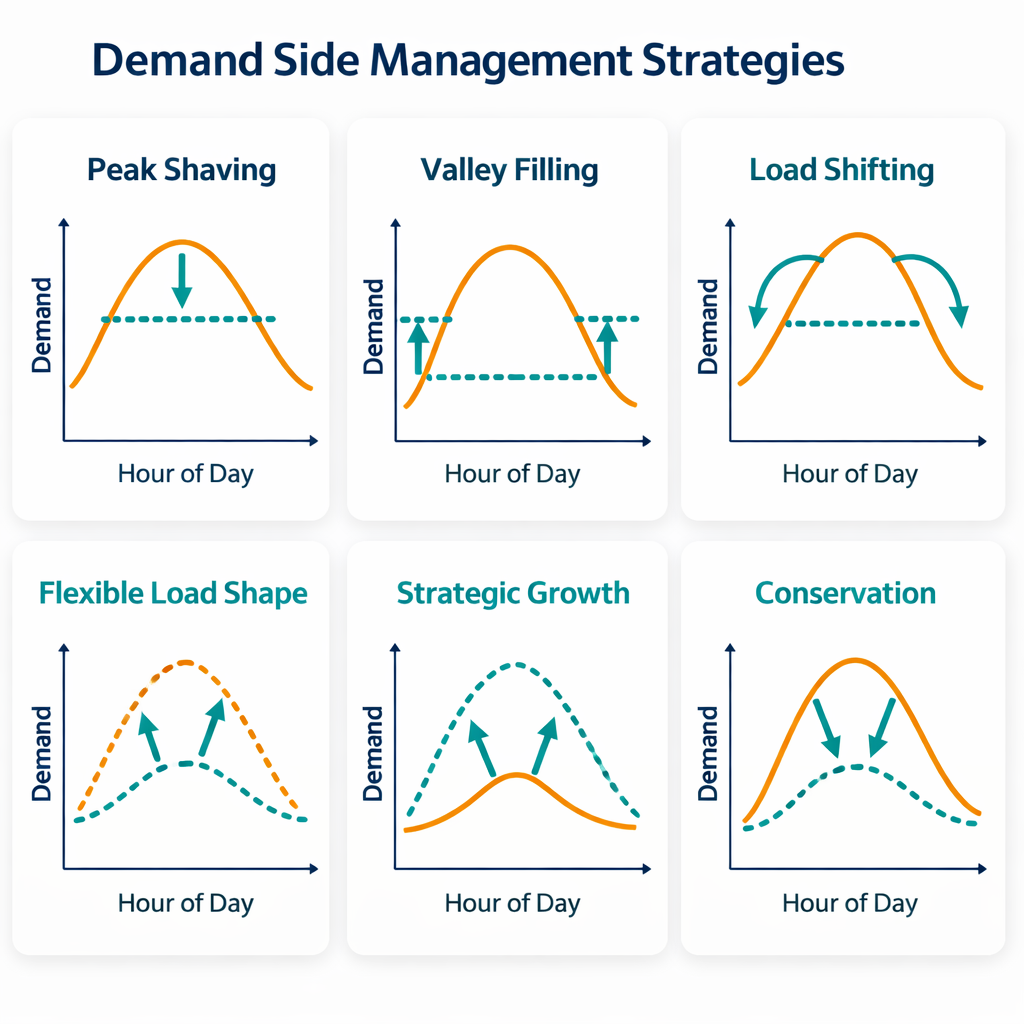
The goal is to reduce demand for spikes, ease stress on the grid, and avoid building additional infrastructure that is only needed to cover peaks. DSM helps reduce demand without needing to increase supply, which becomes more important as fluctuating renewable generation grows.
Electricity is often most expensive during morning or early-evening peaks when many users consume power simultaneously. A company with flexible loads, such as cooling systems, pumps, compressed air, charging processes, or certain production steps, can move non-critical consumption to cheaper hours (for example, late night or periods with high renewable generation).
If a short peak still occurs, the site can temporarily reduce selected loads within predefined safe limits or use on-site storage to keep grid imports below a peak threshold.
DSM typically combines measurement, price signals, automation, and on-site resources:
Measure the load profile: Collect interval data, install submetering, and identify key drivers of demand and inefficiencies.
Identify flexibility and efficiency potential: Determine which loads can be shifted or curtailed, and where structural energy savings can be achieved (e.g., process optimization, equipment performance).
Implement controls: Define manual procedures or use an Energy Management System (EMS) with automated rules.
Execute actions: Reschedule processes, temporarily curtail non-critical loads, improve operational efficiency, or dispatch on-site storage to reduce grid import during peaks.
Continuously optimize load behavior: Adjust consumption dynamically based on external signals (e.g., price, CO₂ intensity, renewable availability) and system conditions.
Participate in external programs (where available): Engage in demand-response or flexibility markets and leverage financial incentives.
The integration of renewable energy sources increases the importance of flexibility on the consumer side, because variable wind and solar make it harder to balance supply and demand. DSM can significantly lower energy costs for industrial enterprises by optimizing energy consumption and reducing exposure to peak prices. On a system level, DSM supports a stable, more renewable-friendly grid by helping balance fluctuating generation and reducing reliance on expensive marginal peak generation. Many energy strategy’s view demand-side flexibility as an important lever for decarbonization and security of supply.
A manufacturing site may shift energy-intensive processes (e.g., batch production or thermal processes) to off-peak hours, while temporarily reducing non-critical loads during peak periods. In parallel, on-site assets such as battery storage or flexible equipment can be used within operational limits to lower grid import. Combined with small efficiency improvements (e.g., optimized setpoints or process tuning), this can reduce peak exposure and energy costs and may unlock incentive opportunities without affecting production targets when properly managed.





We empower industries to make complex energy systems and operations more intelligent, efficient, and resilient — with AI and digital twins that operators can trust.
