
Executive Brief: IEA Energy Efficiency 2025 - Implications for Data Center Cooling
Electricity demand is rising faster than overall energy demand, driven by rising electricity use in industry, higher demand for cooling in buildings, growth in data centers and artificial intelligence, and electrification across sectors. The IEA’s Energy Efficiency 2025 report shows that global efficiency progress is slowing just as electricity use accelerates – a combination with major implications for operators of energy-intensive facilities, including data centers.
Key signals (from the IEA report):
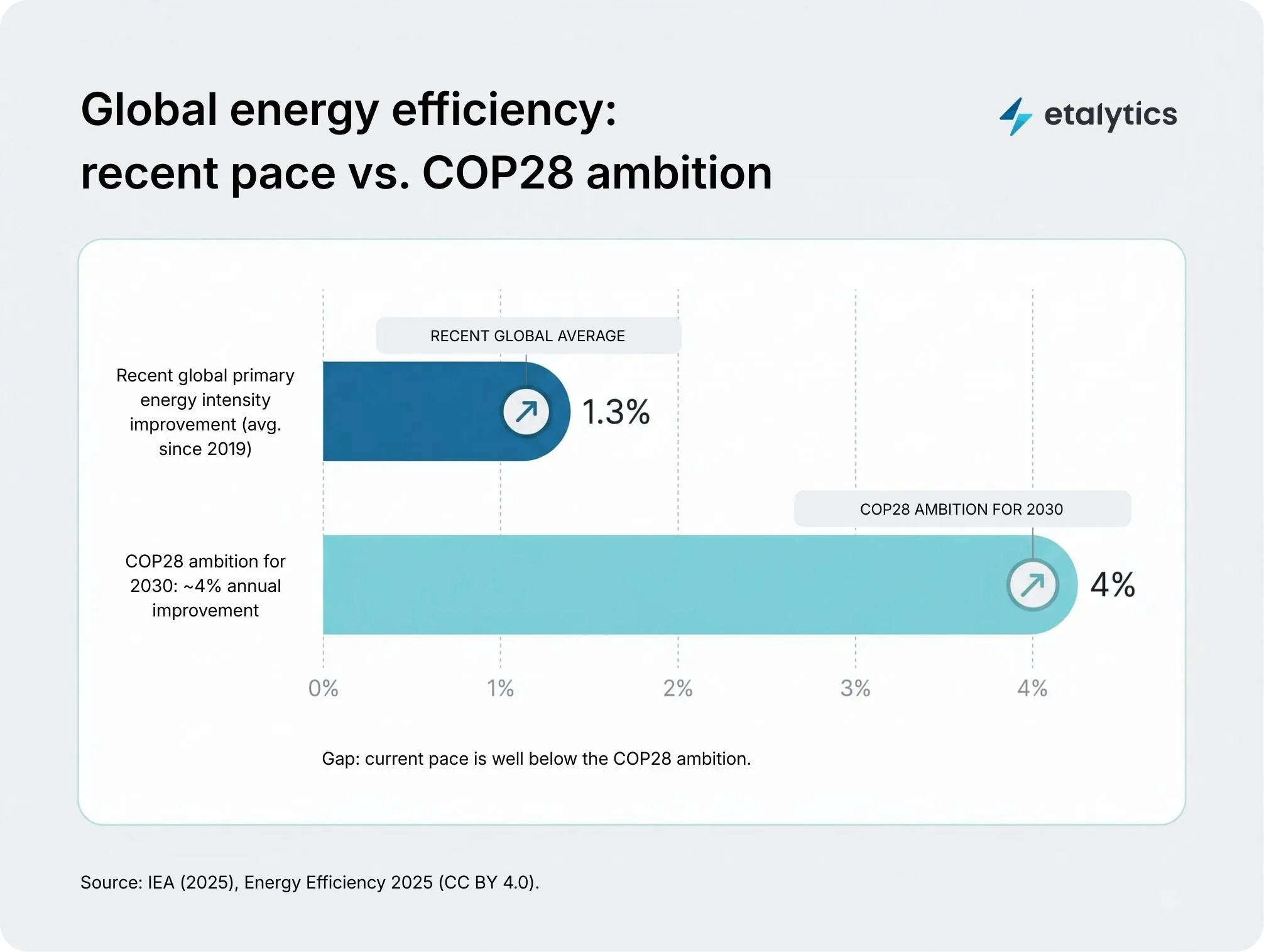
- Global efficiency progress: ~1.3%/year since 2019 (vs. 4% ambition)
- Electricity demand has grown 2-3× faster than overall energy demand since 2019
- 2025 drivers include cooling demand, electrification, and growth in data centers & AI
- Digital optimization is highlighted as a near-term lever (5-40% savings range in buildings)
Global Energy Efficiency Progress Is Off Track
The world is not on pace to reach the COP28target of 4% annual energy efficiency improvement by 2030.
The IEA reports that global primary energy intensity has improved by only ~1.3% per year since 2019, far below what is needed (IEA, Energy Efficiency 2025, Chapter 1, p. 13).
For data centers, whose growth depends on the availability of affordable and reliable electricity, this slowdown matters. Slower efficiency improvements in the broader economy increase pressure on electricity systems already facing unusually rapid demand growth.
Electricity Demand Is Accelerating Faster Than Ever
One of the report’s clearest findings is that electricity demand has grown two to three times faster than overall energy demand since 2019 (IEA, Executive Summary, p. 9).
This acceleration is driven by several factors, including:
- rising global cooling demand,
- greater electrification of buildings and industry, and
- the expansion of data centers and artificial intelligence (IEA, Chapter 1, p. 16)
For operators, this trend underscores the need to reduce avoidable electricity consumption within the facility, especially in cooling, which is typically the largest controllable non-IT load.
How Digital Optimization Improves Data Center Cooling Efficiency
The IEA highlights the potential of digital optimization, including advanced controls, automation, fault detection, and analytics, to improve the efficiency of existing systems. According to the report, such measures typically deliver 5-40% energy savings in commercial facilities (IEA, Buildings Section, p. 65).
For data centers, this is highly relevant. Cooling systems rely on the same fundamental components as large commercial buildings – chillers, cooling towers, pumps, fans, heat exchangers – but operate under tighter performance constraints and higher load variability. That makes them well suited to more adaptive, data-driven optimization approaches.
Building on the IEA’s framing of digital optimization (advanced controls, automation, fault detection, and analytics), data center operators often implement these capabilities through more advanced operational methods. Examples that have become increasingly common in data center environments include:
- Predictive control: Adjusting cooling setpoints based on forecasted IT loads and environmental conditions rather than reactive thresholds.
- Digital twins: Using thermodynamic models of HVAC systems to simulate performance, detect faults, and identify inefficiencies continuously.
- Autonomous optimization: Applying control strategies automatically – within defined safety limits – to achieve system-wide efficiency gains.
In practice, these methods allow data centers to operate closer to their thermodynamic potential, often without hardware upgrades. This positions intelligent cooling as a high-impact strategy for improving energy efficiency, PUE, and operational resilience as AI-driven loads increase.
Leading operators are already deploying AI operations layers. This isn’t theoretical: major operators are investing in AI-driven monitoring, analytics, and optimization to improve cooling efficiency and operational resilience. Equinix has shared results from AI-based cooling optimization projects, Digital Realty has deployed optimization platforms, and NTT Global Data Centers has highlighted AI use cases to reduce cooling energy and improve performance.
Operational Benefits of Data Center Cooling Optimization
Digital improvements in cooling operations create value beyond energy savings. Operational takeaways:
- Operational stability: More responsive control strategies help maintain consistent thermal conditions during high ambient temperatures or shifting IT loads.
- Improved reporting: Higher-quality operational data supports PUE tracking and emissions reporting, particularly as regulatory expectations evolve.
- Demand management: Cooling systems that can adjust within safe limits during peak price periods enable more flexible interaction with the electricity system.
Cooling remains one of the most accessible and high-impact starting points for making data center infrastructure more intelligent.
Looking Ahead: The Operational Layer Becomes the Differentiator
The IEA’s findings underscore the increasing pressure on electricity systems as demand accelerates and efficiency improvements lag. For data centers, this points to a broader shift: the differentiator is increasingly how well existing systems are operated, not just the hardware in place. Cooling systems sit at the center of this transition. Their performance depends on the quality of data, the adaptability of control strategies, and the ability to learn from real operation.
Want to learn more?
If you’re interested in how digital and AI-driven energy optimization approaches can be applied in practice, our team at etalytics is happy to share insights from real projects and discuss what this could mean for your facilities. Feel free to ask a question or start a conversation via our contact form.
Read the full report here: IEA Energy Efficiency 2025 Report