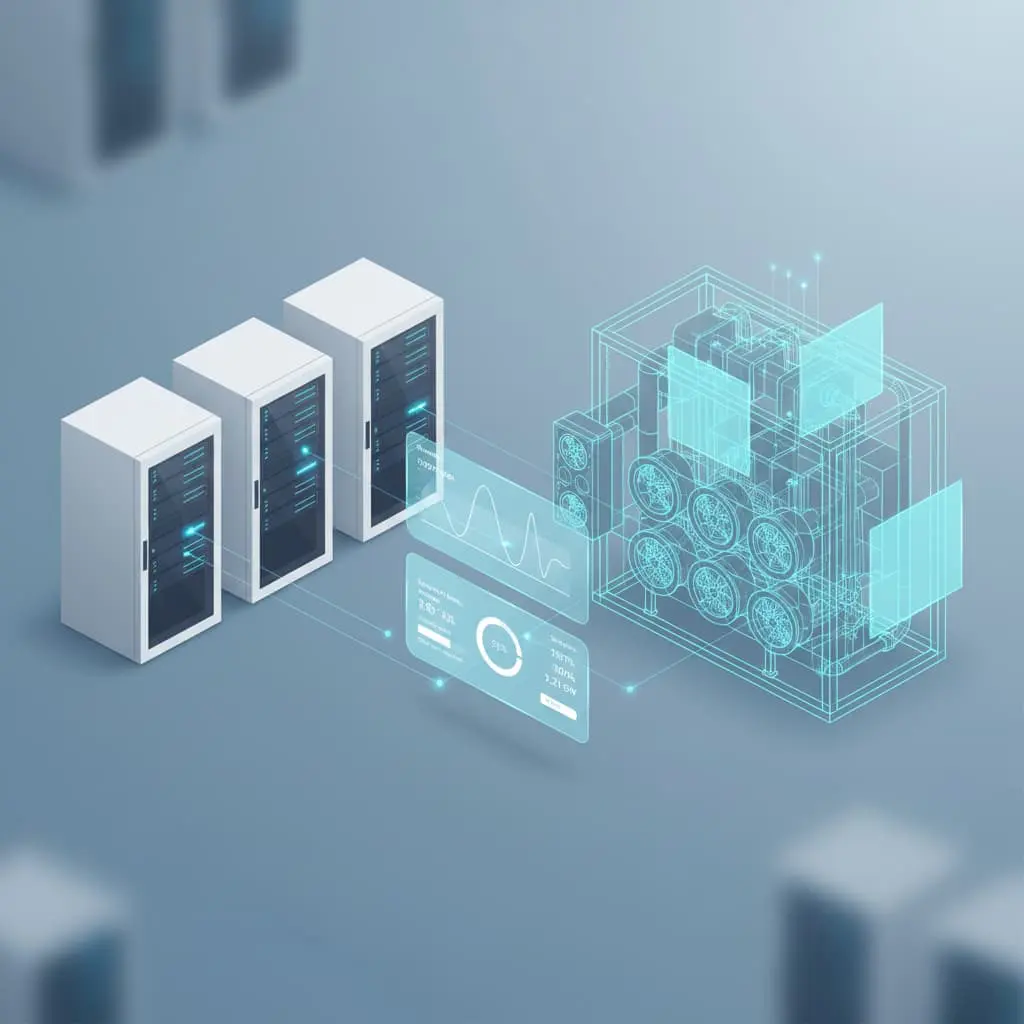
In practice, retrofit projects often face barriers such as planning complexity, operational interruptions, investment costs, and risk considerations. Operators must make decisions that simultaneously address safety, availability, and efficiency. For this reason, “best practice” alone is often not enough—what’s needed are robust, site-specific decision bases. This is exactly where digital twins and AI come into play: they make complex interactions visible, allow different scenarios to be simulated, and help evaluate measures quantitatively—before investing in physical modifications.
The Challenge: Retrofits Require Careful Planning
Retrofit is more than simply “replacing a few components.” Cooling systems have often evolved over time: they are controlled in a decentralized way, not optimally coordinated, and frequently operated with conservative safety margins. While this ensures stability, it also means that efficiency potential remains untapped—especially during part-load operation, when using free cooling, or when coordinating hydraulics and airflow.
Why Retrofit Is Especially Relevant Right Now
In many data centers, retrofit initiatives are driven by a combination of operational realities, efficiency pressure, and technological advancement. Typical triggers include rising energy costs, the desire for improved PUE performance, capacity expansion within existing facilities, or simply the need to make systems more robust and flexible under changing loads.
A recurring insight is that efficiency improvements rarely come from a single measure. Instead, they result from the interaction of control strategies, infrastructure, and overall system philosophy.
The Most Common Retrofit Drivers and Levers in Practice
An evaluation of retrofit measures (35 total mentions, including multiple responses) shows that the perceived potential varies depending on stakeholder groups and categories. The analysis was carried out within the SMART-KS project, a joint initiative by the University of Stuttgart (IER), etalytics GmbH, Iron Mountain Information Management, LLC, and STULZ GmbH . From the perspectives of operators, planners, and technology providers, the most important retrofit topics can be grouped into five clusters: controls, infrastructure, system philosophy, electronics, and IT.
1) Controls: Aligning Operation and Control with Reality
Many of the most effective measures do not begin with hardware but with the question: How is the system operated?
Common examples include:
- Adjusting operating modes (e.g., setpoints, control strategies, load- or weather-dependent operation)
- Implementing variable speed control to enable part-load operation (fans and pumps)
- Retrofitting PICVs (Pressure Independent Control Valves) to enable variable flow rates
- Retrofitting or more consistently utilizing free cooling
Part-load operation is often an underestimated level. Data centers rarely run continuously at peak load. Designing control strategies that respond dynamically and reliably to changing loads can significantly improve efficiency—without compromising operational reliability.
2) Infrastructure: Optimizing Hydraulics, Airflow, and Components
Retrofits also frequently address the physical reality of the cooling infrastructure. Common measures include:
- Hydraulic balancing
- Raising dry coolers or chillers to improve performance
- Adjusting airflow using CFD simulations to reduce hotspots and bypass air
- Deploying RDHX (Rear Door Heat Exchangers) to relieve room-level cooling
- Retrofitting frost protection for dry coolers
- Implementing hot- and cold-aisle containment to reduce air mixing and losses
- Installing new expansion valves as a prerequisite for higher system temperatures
These measures aim to reduce losses, eliminate bottlenecks, and increase the system’s tolerance for higher temperatures, making free cooling and more efficient operating modes easier to implement.
3) System Philosophy: Rethinking Temperature Levels and the Cooling Loop
A particularly interesting field is the optimization of temperature levels. In many cases, efficiency can improve when system temperatures are increased appropriately—provided that the entire cooling chain supports it.
Typical measures include:
- Increasing overall system temperature levels
- Replacing refrigerants
- Eliminating unnecessary heat exchangers to avoid additional temperature lifts
A practical example: many data centers operate supply air temperatures conservatively around 22–24 °C. In suitable environments, higher temperatures may be possible—improving efficiency and enabling more frequent use of free cooling. However, this requires that all components across the cooling chain are designed accordingly.
4) Electronics: Improving Drive Efficiency and Power Quality
Electrical aspects also appear as retrofit drivers, particularly in facilities with numerous drives and power electronics:
- Reducing harmonic distortion
- Upgrading motors (e.g., from IE3 to IE4 efficiency class)
These measures may seem less spectacular at first glance, but together they can contribute to more stable and efficient operating conditions.
5) IT: Positioning Heat Sources More Strategically
Even within the IT infrastructure itself, there are opportunities:
- Optimizing IT positioning (layout and load distribution)
Cooling performance is determined not only by the technology used but also by where and how heat loads are generated—and whether airflow and cooling capacity match those patterns.
Digital Twins and AI: From Assumptions to Measurable Decisions
This is where digital twins and AI become particularly valuable. A digital twin virtually replicates the cooling system, allowing operators to simulate different operating scenarios and retrofit options. AI-driven optimization can further support the process by helping to:
- quantitatively evaluate measures (energy consumption, cost, and stability),
- better understanding interactions between components,
- dynamically adapt operation to changing load conditions, and
- translate improvements into a prioritized implementation roadmap.
The key benefit is confidence in decision-making. Instead of saying, “We think this might help,” operators can say, “We can prove it in the model—and then implement it in a controlled way in live operations.”
Conclusion: Retrofit Is the fastest Path to Higher Efficiency—If Done Systemically
Retrofit in data center cooling is not a single modification but a systemic process. Controls, infrastructure, and temperature levels all interact. The most common drivers range from smarter operational strategies and part-load capability to free cooling, improved hydraulics and airflow, motor efficiency, and optimized IT layout.
Organizations that evaluate these factors holistically and data-driven can achieve significant improvements—without building new infrastructure, but with lasting impact on PUE, operating costs, and carbon footprint.
Digital twins and AI provide the foundation for this approach: they transform retrofit from a matter of intuition into a data-backed engineering decision.

cci Zeitung, AUSGABE: 01/2026
Universität Stuttgart, IER Institut für Energiewirtschaft und Rationelle Energieanwendung, SMART-KS - System zur Minimierung des PUE (Power Usage Effectiveness) durch Anwendung von Retrofit-Technologien in Kälte-Systemen von Rechenzentren #Link