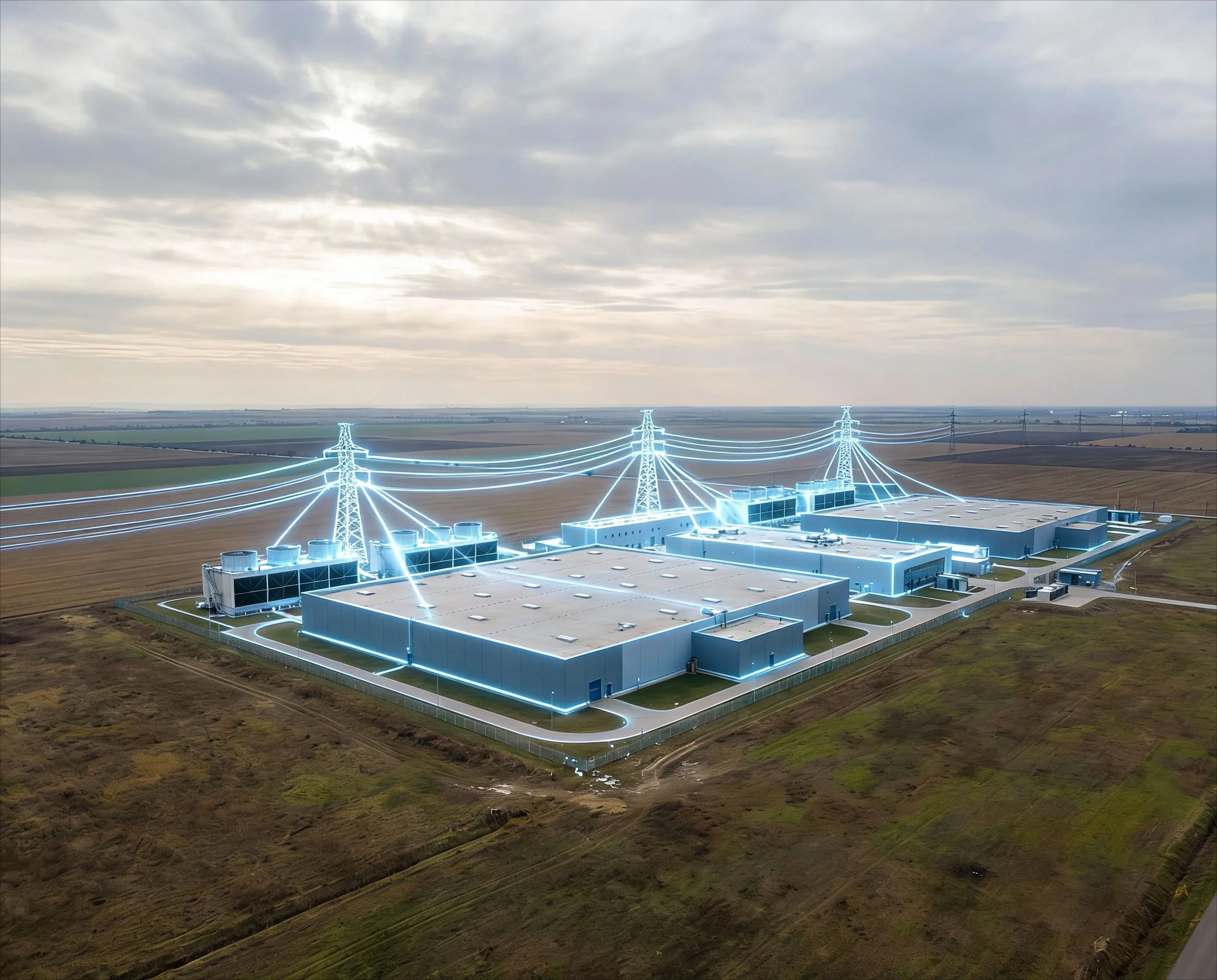
The energy landscape in 2026 continues undergoing a structural shift. In some regions, data centers are approaching power-plant scale, turning them from conventional IT consumers into system-level electricity loads. As a result, the way facilities operate is becoming as important as how much power they procure.
This shift is most visible in Texas. In late 2025, the Electric Reliability Council of Texas (ERCOT) reported a sharp increase in large-load interconnection requests, driven largely by data centers. While not all proposed projects will be built, the volume and size of requests signal a structural change in how large loads interact with power systems. (Latitude Media, 2025)
AI-Driven Data Center Demand at Gigawatt Scale
As of November 2025, ERCOT was tracking approximately 226 GW of large-load interconnection requests, up from about 63 GW in December 2024, with about 73% attributed to data centers. ERCOT also noted that many proposed sites exceed 1 GW of peak demand. (Latitude Media, 2025; Yahoo Finance, 2025)
.webp)
To put this in context, 1 GW is power-plant scale. Sustained over time, a 1 GW load corresponds to the annual electricity consumption of roughly 800,000–900,000 average U.S. households, based on typical residential electricity use. At that scale, a single facility is no longer just another customer on the grid, but a system-level load that must be planned for accordingly.
Texas is an extreme case, but not an isolated one. The U.S. Energy Information Administration expects U.S. electricity consumption to reach new highs in 2025 and 2026, and has cited data centers (including AI-related demand) among the drivers behind rising power use. (EIA, 2025)
At the global level, the International Energy Agency similarly highlights accelerating electricity demand alongside slower-than-needed efficiency progress, noting that data centers and AI are becoming an increasingly relevant factor in electricity systems in advanced economies.
Related: our summary of the IEA’s Energy Efficiency 2025 report and what it signals for data center cooling operations.
Why This Matters Beyond Texas: While ERCOT is currently the most visible example, similar dynamics are emerging in other regions where AI-driven data center growth collides with transmission constraints, permitting timelines, and reliability requirements. The underlying challenge is not regional – it is structural.
Why Gigawatt Requests Matter for Grid Planning and Interconnection
Grid interconnection processes were designed for a world in which large industrial loads typically arrived more gradually. Today’s hundreds-of-megawatts-to-gigawatt-scale requests fundamentally change that planning logic in three ways.
First, volume. When very large-load requests surge, grid studies and infrastructure lead times become binding constraints long before a new facility is energized. (ERCOT, 2025)
Second, concentration. When multiple large projects target the same region, the local challenge shifts from “adding a customer” to “rebalancing an entire area,” often requiring major transmission upgrades or new substations.
Third, behavior. At this scale, stakeholders care not only about maximum demand, but about how the load behaves under real operating conditions: peaks, ramps, contingency events, and disturbances. The North American Electric Reliability Corporation (NERC) explicitly warns that “large loads” can pose reliability risks due to their operational characteristics, and calls for stronger interconnection processes, studies, and operational communication. (NERC, 2025)
In Texas, ERCOT defines a “large load” as a customer with 75 MW or more of peak demand at a single site and applies dedicated studies to assess system impacts. (ERCOT, 2025)
Operational Priorities for Grid-Aware Data Centers
In this context, grid-aware operations refer to a data center’s ability to understand, predict, and actively manage its electrical and thermal behavior in alignment with grid constraints and operating conditions
In this environment, the traditional metric of “how much power you can secure” is becoming secondary to how intelligently you use it.
From a grid perspective, uncertainty is costly. Large, unmanaged load swings complicate forecasting and reserve planning. For operators, this places new emphasis on predictability, controllability, and transparency, especially as AI-driven workloads increase variability in both compute and cooling demand.
Three operational capabilities become especially relevant:
- Load predictability. Understanding how IT demand, cooling demand, ambient conditions, and on-site assets (such as backup generation or batteries) interact – and being able to explain those dynamics when needed.
- Cooling as a controllable lever. Cooling is typically the largest non-IT electrical load. While uptime is non-negotiable, cooling behavior is often more adjustable than compute – for example through load shifting within thermal inertia and pre-cooling ahead of peak grid hours. It is therefore a key lever for smoothing peaks within safe operating limits.
- Operational transparency. Clear measurement and reporting of how facilities behave during tight grid hours reduce friction in interconnection studies and stakeholder discussions.
For AI-heavy sites, cooling and power constraints are increasingly coupled. We explore what that means for control strategy in next-gen (liquid-dominant) cooling in this blog post: Next-level cooling for AI data centers
From Capacity Planning to Operational Credibility
Gigawatt-scale demand changes how data centers are evaluated. At this level, electricity is no longer only a procurement question, but becomes a planning and operational topic that affects grid studies, approvals, and long-term scalability.
What increasingly differentiates operators is not simply how much capacity they can request, but how credibly they can explain and manage their load: how predictable it is, how it behaves during peak conditions, and how transparently it can be communicated to grid stakeholders.
As electricity demand continues to rise – driven in part by AI-related workloads – this operational credibility becomes a practical advantage. It reduces uncertainty in interconnection processes, supports more constructive discussions with utilities and regulators, and ultimately influences who can build and scale with fewer constraints.

Want to go deeper?
Grid-aware operations increasingly depend on how well large energy systems are monitored, controlled, and adapted in real time. At etalytics, we work with operators of complex energy infrastructure – including data center cooling systems – improve efficiency, resilience, and operational performance through AI-driven optimization.
If you’d like to sanity-check how your cooling operations behave under real-world conditions, we’re happy to compare notes or share examples from recent projects.
→ Ask a question or start a conversation via our contact form
→ Explore selected success stories