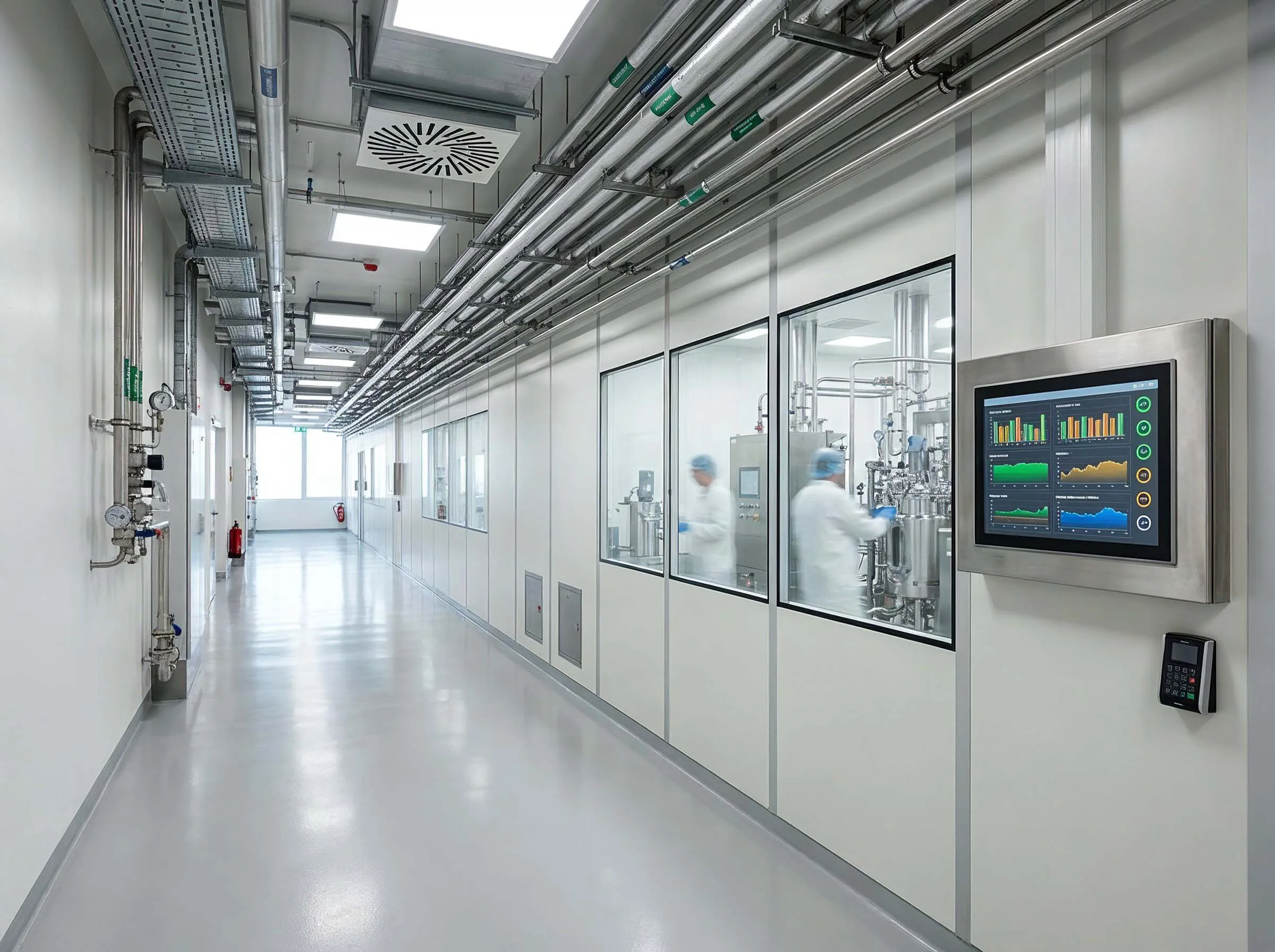
Pharma manufacturing in 2026 is defined by a practical challenge: plants are expected to run more reliably, more efficiently, and with stronger data integrity while operating conditions keep getting less predictable.
PharmTech’s Industry Outlook 2026 describes a year where AI adoption, sustainability pressure, and operational resilience are moving from pilot talk to execution, with more focus on data integrity and “can we actually run this at scale.” (PharmTech) ISPE’s Top Five Future Trends for 2026 similarly highlights the expansion of advanced analytics, digital transformation, and efficiency-driven modernization across pharmaceutical operations. (ISPE) This post translates that into what changes inside plants and where manufacturing teams can start.
In this article you will find:
- A plain-language definition of operational resilience for GMP manufacturing
- Why sustainability is shifting from reporting to day-to-day operating decisions
- Where AI can deliver measurable results first without creating unnecessary validation risk
- A practical checklist for leaders and plant teams
What does “operational resilience” mean in pharma manufacturing in 2026?
Operational resilience in pharma manufacturing means maintaining compliant production and product quality when the real world gets messy: equipment performance drifts, utilities fluctuate, staffing is tight, and supply chains cause schedule changes. It is not only about contingency plans. It is about how stable your processes and supporting systems stay day to day. (PharmTech)
A practical way to think about it is a set of stress tests manufacturing teams already recognize:
Common resilience stress tests inside plants
- Utilities instability: chilled water, steam, compressed air, or HVAC performance drifting from expected behavior
- Environmental control variability: temperature, humidity, and differential pressure stability under changing loads
- Maintenance uncertainty: reactive fixes, alarm fatigue, and late detection of degradation
- Schedule volatility: more changeovers, smaller batches, or non-standard production patterns
- Data gaps: missing context, inconsistent tagging, limited traceability across systems (PharmTech)
The thread across all of these is not “more data.” It is better control of the system, with evidence that it stays in control.
Why sustainability is moving from reporting to operating decisions
Sustainability used to be handled mostly as reporting. In 2026, it is increasingly operational: energy and carbon are becoming everyday KPIs, not just annual numbers. (PharmTech)
That shift matters because in many clean manufacturing facilities, HVAC and environmental control dominate the energy profile. ISPE has described HVAC as consuming a large share of energy in clean manufacturing facilities, which means performance improvements here can have outsized impact when done safely. (ISPE)
If HVAC is a big lever, then sustainability becomes less about declarations and more about questions such as:
- Are we running airflows and setpoints based on current needs or historic conservatism?
- Are we detecting drift early enough to prevent deviations and waste?
- Do we know the energy cost of stability, and can we reduce it without reducing stability?
Most pharma sites already collect data in BMS, historians, and meters, but the information is fragmented and hard to interpret consistently across operating modes. An AI-capable energy management system brings these signals together, adds operating context, and makes performance comparable over time, so teams can answer the questions above with traceable data and documented actions. AI can identify likely drivers of inefficiency or drift and recommend corrective actions. And where operational boundaries are clearly defined, it can also autonomously optimize control decisions such as equipment sequencing or setpoint adjustments.
Where AI delivers measurable wins first: utilities, HVAC, and thermal systems
AI in pharma is often discussed as if it starts with high-impact, high-risk areas. In manufacturing, a more practical lens is: start where outcomes are measurable and constraints are clear.
Utilities and HVAC often meet those conditions:
- They generate consistent time-series data (BMS, historians, meter data).
- Performance can be expressed in operational KPIs (stability, excursions avoided, energy intensity).
- Optimization can be constrained within safe boundaries.
- Benefits show up in both cost and carbon, while supporting uptime and quality.
In practice, the biggest bottleneck is often navigation. Industrial HVAC and utility systems are complex, and engineering teams are time-constrained. AI assistants can help by summarizing current operating conditions, pointing to the subsystem that changed, and highlighting likely drivers of inefficiency or drift. This does not replace engineering judgement. It reduces the time spent searching and helps teams focus on measures that are safe and measurable.
Examples of “bounded” use cases that manufacturing teams can validate
1) Chilled water plant sequencing and setpoint optimization
Goal: meet cooling demand with fewer inefficiencies.
Boundaries: minimum temperatures, redundancy logic, equipment limits, alarms.
2) Air-handling unit control stability and reset strategies
Goal: reduce over-conditioning while maintaining environmental control.
Boundaries: validated limits for temperature, humidity, and pressure differentials.
3) Fault detection and performance drift monitoring
Goal: catch degradation before it becomes a deviation, scrap, or emergency intervention.
Boundaries: alert thresholds, escalation workflows, documented investigation steps.
This is also where AI can be useful without “touching product” in the narrow sense. It supports the conditions that keep product safe and compliant.
It also creates the basis for more efficient energy management workflows: automated detection of abnormal patterns, consistent baselining, and reporting that can be generated from the same monitored signals.
Trust requirements: auditability, governance, and operator acceptance
PharmTech flags that data integrity and execution capability are central. (PharmTech) On the plant floor, “trust” is not a feeling. It is a set of requirements manufacturing teams already know from validation and change control.
What “trusted AI” looks like in practice
Auditability
- Decisions are logged with time, state, and inputs
- Setpoint changes and control actions are traceable
- Performance evidence is preserved, not just dashboards
Governance
- Clear ownership: engineering, QA, IT/OT, and operations alignment
- A defined scope: what the system can influence and what it cannot
- A documented process for changes, tuning, and updates
Operator acceptance
- Clear explanations in plant language
- “Why did the system do that” is answerable without reverse engineering
- Fail-safe modes exist and are tested
If any of these are missing, AI will struggle to move beyond a pilot, regardless of technical capability.
Leadership checklist: what to ask before scaling AI in manufacturing operations
This checklist is designed to keep the conversation practical. It is not a vendor checklist. It is what plant teams can use to avoid chasing “AI initiatives” that do not hold up under day-to-day reality.
1) What is the specific operating problem we are solving?
Examples: humidity instability, high energy per batch, frequent alarms, drift, seasonal instability.
2) Can we define success in operational terms?
Examples: fewer excursions, tighter stability bands, fewer overrides, verified kWh reduction.
3) What are the non-negotiable constraints?
Validated limits, redundancy logic, equipment envelopes, safety conditions.
4) Do we have the minimum viable data foundation?
- Time synchronization
- Consistent tagging and asset hierarchy
- Sensor quality checks
- Context that explains production state and operating mode (PharmTech)
5) How will we prove cause and effect?
If energy or stability improves, can you attribute it to the control change and not to weather or production mix? Plan measurement and verification early.
6) What is the human workflow?
Who reviews recommendations, approves changes, investigates anomalies, and documents outcomes?
7) What is the rollout path?
A typical risk-controlled path is: advisory recommendations, supervised optimization, then automation only where proven safe.
Conclusion: the practical 2026 shift is from “AI projects” to “controlled performance”
The most important pharma manufacturing trend in 2026 is not the latest model or platform. It is the shift to measurable, governed operational improvement, especially where energy, stability, and resilience intersect. (PharmTech)
If you are planning where to begin, utilities and HVAC are often the best starting point because the constraints are explicit and the impact can be measured without rewriting production processes. Beyond cost and carbon, this is also where an AI-capable energy management layer can reduce ongoing analysis and reporting effort by improving transparency and standardizing evidence over time.
Next step: pick one bounded utility system, define constraints and KPIs, and run a time-boxed evaluation using existing BMS and meter data. A feasibility study can quantify savings potential and de-risk implementation before you scale to more systems.

Source list
Further reading
etalytics helps pharmaceutical manufacturers improve HVAC and cooling systems with AI-driven energy intelligence. Using digital twins, predictive analytics, and autonomous optimization, etaONE analyzes real-time plant data, identifies inefficiencies, and adjusts operating strategies within defined limits to reduce energy use, emissions, and costs while supporting reliability and compliance.
- Merck saved 21% energy in cooling with this approach: Read Merck's success story.
- For teams evaluating similar opportunities, etalytics also offers a free feasibility study.