Many companies are currently asking how AI can improve workflows, speed up decisions, and make teams more productive.
It is a valid question. But in industrial energy optimization, it is only part of the picture.
A general AI assistant can help people find information faster, understand complexity more quickly, and move through decisions more efficiently. That is valuable.
But that is not the same as optimizing an industrial energy system.
A live cooling system, HVAC infrastructure, or broader utility network is not just an information challenge. It is a physical, operational system with constraints, dependencies, and real-world consequences. Improving efficiency in that environment requires a very different kind of intelligence.
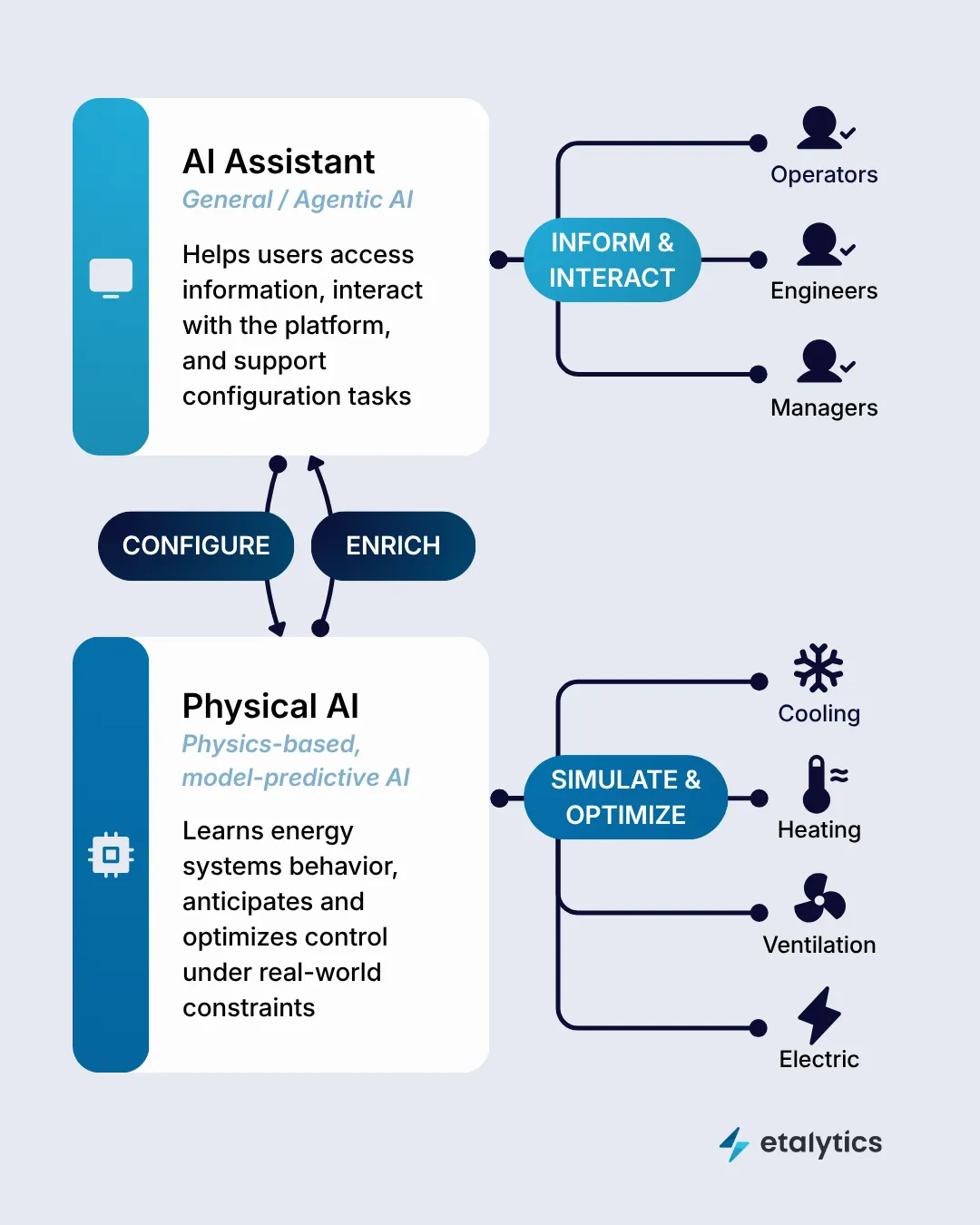
To create real value, companies need both:
- specialized “physical AI” that understands and optimizes the physical system behavior
- general AI assistance that helps people work with that system more effectively
That is where AI starts to create real value in operations.
What general AI can and cannot do in industrial energy management
General AI is useful where language and information are the bottleneck. It can summarize reports, answer questions, simplify access to documentation, and help teams move faster through complex information.
That matters in industrial environments, where operations teams often work across complex systems with limited time and growing data volumes.
But a general AI assistant is not designed to come up with optimal trajectories for complex interconnected physical systems – to decide how a chiller plant should respond to changing load, how a cooling network should be operated across varying conditions, or how a utility system should balance efficiency with reliability.
Those systems do not operate in language. They operate through thermodynamics, equipment behavior, control logic, ambient conditions, and operating limits.
In industrial energy systems, optimization needs to be built around the behavior of the physical infrastructure itself.
That is where specialized optimization AI creates a clear advantage. Instead of only interpreting information, it helps determine how the system should operate under current and predicted conditions.
In cooling, heating, ventilation and on-site generation applications, that kind of system-level optimization can unlock substantial efficiency gains. In some cases, energy savings can reach up to 80 percent when optimization is applied to the live system in a structured and reliable way.
A practical framework: the two-layer AI model
In our view, the future is not one AI trying to do everything.
It is a two-layer AI model.
Layer 1: Specialized optimization AI for the physical system
The first layer works directly on the energy system itself. Its role is to improve performance, reduce waste, maintain reliability, and identify better operating strategies across the full system.
In industrial environments, that means understanding:
- physical behavior
- system interactions
- operational constraints
- performance trade-offs
- site-specific requirements
This is the layer that actually optimizes how the system runs.
Layer 2: General AI assistance for the people working with the system
The second layer supports operators, engineers, and managers in working more effectively with that infrastructure.
It can help users:
- access information faster
- interpret system data more easily
- navigate complex system structures
- move through analysis and decisions more efficiently
This layer does not replace the optimization engine. It complements it.
A simple way to think about it is this:
- the optimization AI acts on the system
- the assistant AI acts as the interface for people
Both matter. But they are not interchangeable.
Why specialized physical AI and model-predictive approaches outperform generalized deep learning in critical infrastructure
Generalized deep neural networks can be powerful tools in many contexts. But in critical infrastructure energy management, they are not always the best fit.
These environments demand:
- reliability
- transparency
- controllability
- strong performance under constraints
- efficient deployment in real operating environments
A black-box model may produce good predictions in some situations. But optimization in live energy systems requires more than prediction. It requires system-level intelligence that can operate safely and effectively in a physical environment.
That is why specialized physical AI and model-predictive optimization approaches are often the better fit where robustness, transparency, and data efficiency matter. These approaches are especially well suited to industrial energy optimization for four main reasons.
Robustness in live operations
Critical infrastructure needs reliable optimization, not just theoretical model performance. Physics-based and model-predictive approaches are built around the operational reality of the system, making them highly robust in dynamic environments.
Data efficiency
Many generalized AI approaches, especially deep learning models, depend on very large data volumes for training and tuning. In industrial environments, that is often impractical or inefficient. For training purposes often synthetical data must be generated based on simulations which always deviate from reality.
A physics-based approach can achieve strong results with far less historical data because it incorporates system understanding directly into the optimization process.
Transparent and understandable decisions
In industrial settings, explainability matters. Operators and engineers need to understand why a system is making a recommendation or taking a certain action.
That is one of the major strengths of a physics-based, model-predictive optimization approach: decisions are more transparent, understandable, and easier to validate in the context of real operations.
Scalability across sites and applications
A specialized optimization architecture that combines physical understanding with AI can also scale efficiently across different systems, sites, and industrial use cases.
For companies operating multiple assets or locations, that scalability is critical.
Where this matters most: data centers, automotive, and pharma:
This difference between specialized optimization AI and generalized deep learning matters most in industries where energy systems are both complex and business-critical.
That includes: data centers with highly sensitive cooling infrastructure, automotive facilities with energy-intensive cooling and ventilation systems, and pharmaceutical and process industries with complex utility networks and strict operating requirements.
The etalytics perspective
This is the direction we are building at etalytics.
Our optimization technology is designed to improve the performance of live industrial energy systems through physics-based, model-predictive optimization enhanced by AI.
At the same time, our new LLM-powered Assistant, is designed to make system information easier to access and use in day-to-day operations.
Together, these two capabilities help improve both system performance and the way people work with the system.
Want to learn how specialized AI can improve industrial energy performance?
Get in touch with etalytics to explore how physics-based optimization and AI assistance can support your operations.
Or explore our success stories to see how companies are already using AI to reduce energy consumption.