
Industrial energy is entering a new era: electricity price spreads are widening, volatility is increasing, and grid cost mechanisms punish peaks more than ever. Energy efficiency still matters – but it no longer tells the full cost story. The winners combine energy efficiency (use less) with energy flexibility (use smarter: shift, store, generate, and control). This article explains the difference, the business case, and a practical roadmap – powered by energy intelligence, real-time monitoring, digital twins, and AI-driven energy optimization.
Why energy flexibility is suddenly everywhere
For years, the dominant strategy in industry was straightforward: reduce kWh, reduce cost. That still works – but markets are changing fast.
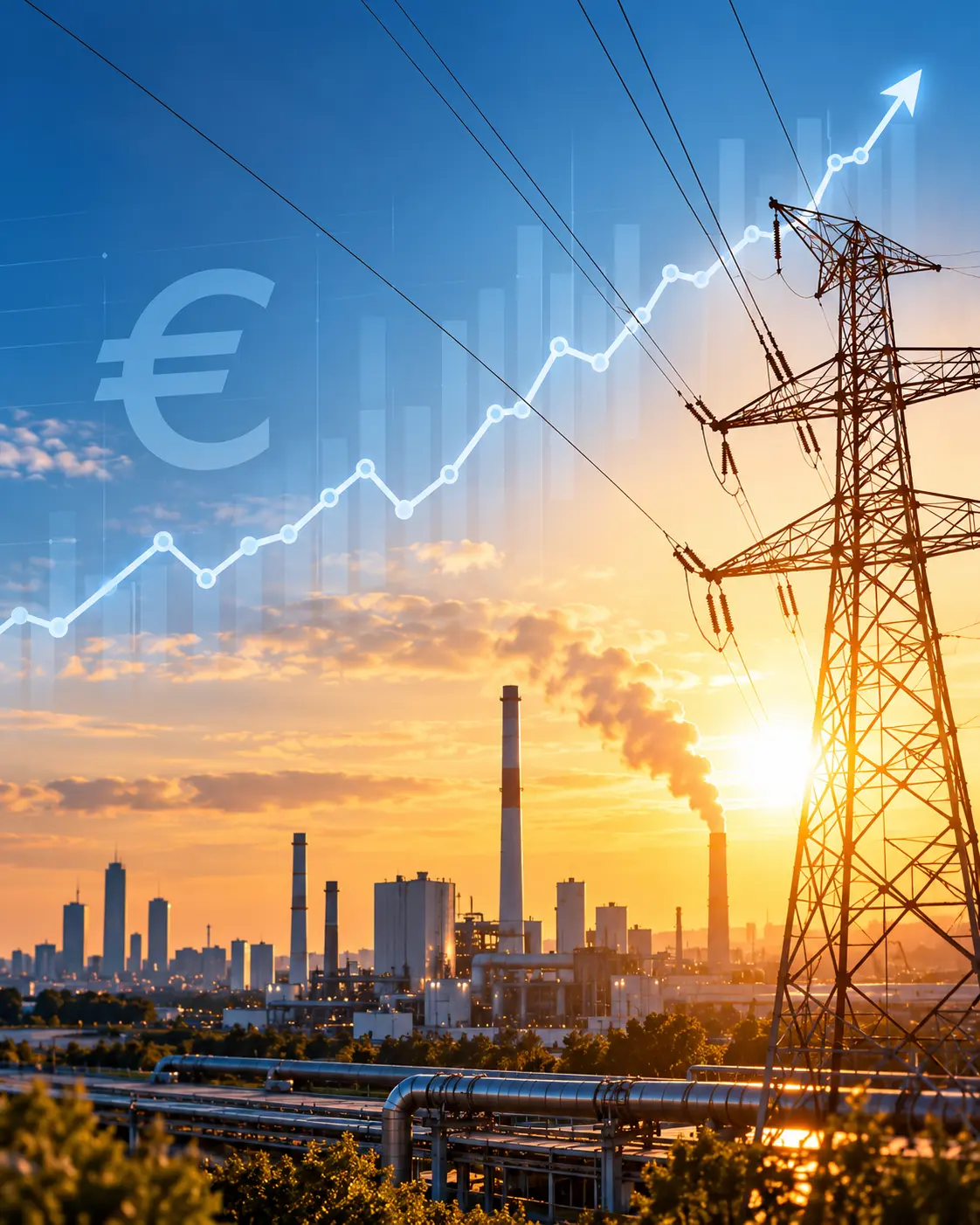
Electricity markets increasingly show high price peaks, strong volatility, and large spreads, including a growing number of negative price hours. For example, a German market review of EPEX Spot data highlights “strong price volatility and continued high price spreads,” and reports almost 460 hours of negative prices in 2024. (FfE)
In parallel, European spot markets have shown significantly larger price spreads in early 2025 compared to 2024 in volatility assessments reported by market analysts. (S&P Global)
This volatility creates a new kind of opportunity:
- Use energy when it’s cheap (or even negatively priced)
- Avoid energy use when it’s expensive by shifting loads or using storage
- Turn controllable loads and assets into value (flexibility, demand response, ancillary services)
In other words: markets are rewarding those who can adapt consumption dynamically.
Energy efficiency vs. energy flexibility: not competitors – complements
Energy efficiency (EE)
Energy efficiency means delivering the same output (products, throughput, quality) with less energy input – reducing kWh per part, kWh per batch, or kWh per operating hour.
This is the foundation. Efficiency reduces:
- energy consumption and emissions permanently
- equipment wear (often)
- baseline operating cost
Energy flexibility (EF)
Energy flexibility means the ability to shift, modulate, or substitute energy consumption overtime (and sometimes across energy carriers) while maintaining operational constraints (quality, safety, throughput). Industry flexibility is increasingly discussed as a critical tool for balancing variable renewables. (ScienceDirect)
A practical way to remember the difference:
- Efficiency: How much energy do we need?
- Flexibility: When do we need it – and from where?
Why you must optimize them together
Flexibility can sometimes reduce local efficiency. The classic example: storage losses.
A battery or thermal storage has losses – so kWh consumed may rise slightly. But if the price spread is large enough, total cost can still drop dramatically.
Example (simplified):
If you charge 1.0 MWh at €50/MWh and discharge 0.9 MWh during €150/MWh hours (90% round-trip efficiency), the “delivered” energy value is €135 vs a €50 cost – even though efficiency decreased due to losses. The site’s kWh goes up slightly, but € goes down.
That’s why the right target is not “minimize kWh at all costs,” but rather:
Minimize total energy cost and CO₂, while respecting production constraints and grid charges.
What “energy cost” really means in industrial reality
When industry leaders say “energy is expensive,” they usually mean more than the commodity kWh price.
A holistic industrial energy cost model typically includes:
- Energy procurement costs (€/MWh, spot vs. fixed, peak/off-peak, imbalance exposure)
- Grid charges / demand charges (often driven by peak kW and tariff design)
- Taxes, levies, regulatory charges (country-specific)
- Operational side-effects (wear, maintenance, ramping costs, reduced lifetime, additional starts)
- CO₂ costs / carbon reporting impacts (ETS exposure, internal carbon price, ESG reporting)
Germany-specific: Netzentgelte and the “hidden” flexibility lever
In Germany, grid fee mechanisms can become a major driver of the business case for flexibility.
Under §19 StromNEV, certain industrial consumers can agree on individual grid charges if:
- their annual peak load occurs predictably in low-load times (atypical grid usage) or
- they use the grid very intensively (e.g., ≥7,000 hours and 10 GWh/year). (Bundesnetzagentur)
This matters because market-adaptive flexibility is not only about buying cheaper energy – it must also consider grid cost logic, especially peak management and special tariff regimes.
Demand Response vs. Demand Side Management: what’s the difference?
These terms are often mixed – so let’s clarify them.
Demand Response (DR)
The IEA defines demand response as balancing the grid by encouraging customers to shift demand to times when electricity is more plentiful or demand is lower, typically via prices or monetary incentives. (IEA)
The IEA also distinguishes:
- Price-based (implicit) DR: tariffs / dynamic prices encourage shifting
- Incentive-based (explicit) DR: direct payments for load changes in programs/markets (IEA)
Demand Side Management (DSM)
DSM is the umbrella. A widely used framing (e.g., ACEEE) describes core DSM approaches as:
- energy efficiency programs
- demand response programs
- distributed energy resources (DERs) (e.g., on-site generation, storage) (aceee.org)
In practice:
- DR is often “event-based” or market/program participation.
- DSM is the full portfolio strategy that combines efficiency + flexibility + DER orchestration.
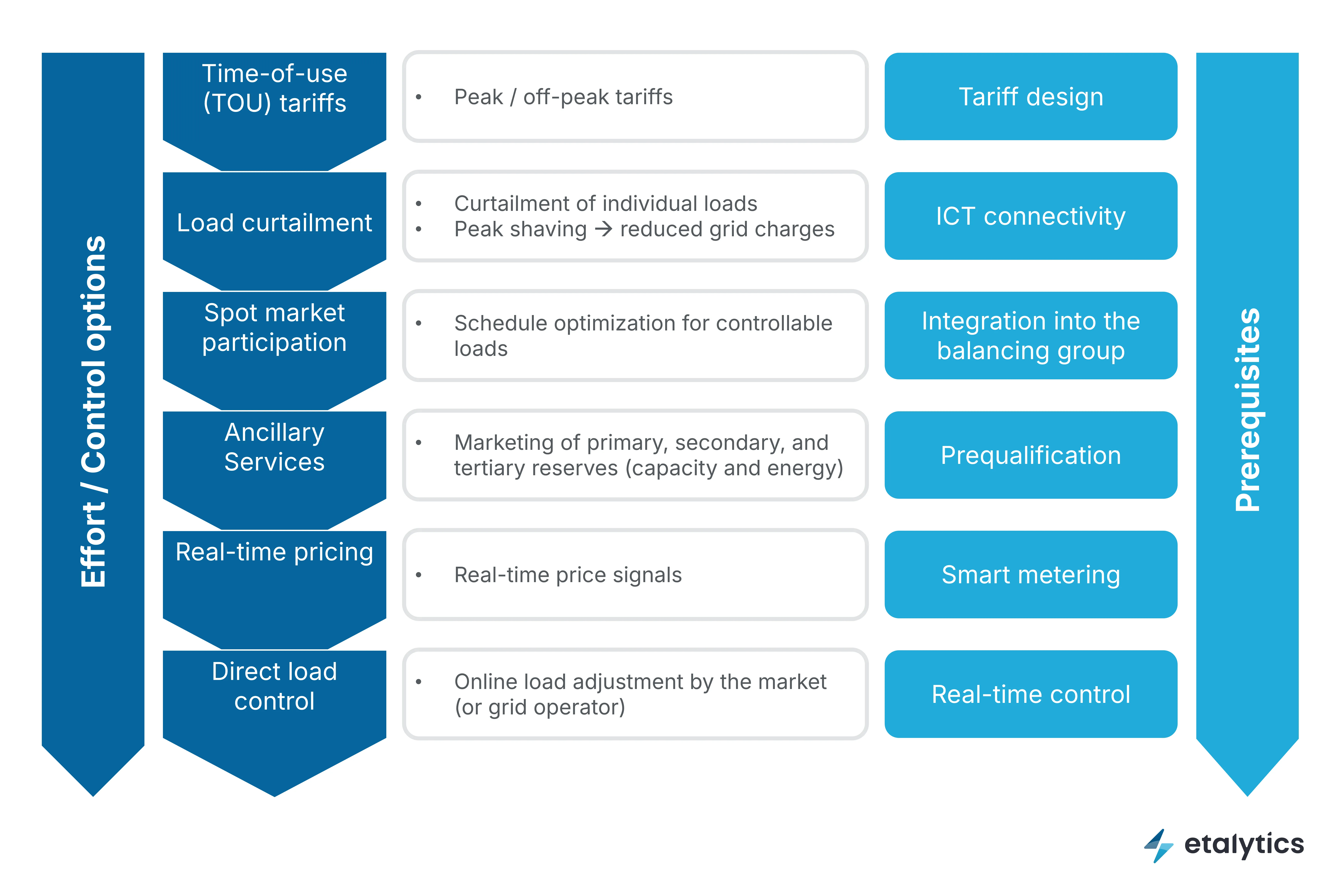
The industrial flexibility tool box: measures that actually move the needle
Industrial flexibility isn’t one thing – it’s a portfolio. Common measures include:
1) Load shifting
Move energy-intensive steps to cheaper windows:
- batch processes (washing/cleaning, drying, heat treatment)
- compressed air generation scheduling
- HVAC operation aligned with occupancy/production windows
- chillers / cooling systems with pre-cooling strategies (within constraints)
2) Peak shaving
Reduce peak kW by coordinating assets:
- stagger starts, ramp limits
- temporarily reduce non-critical loads
- discharge storage during peaks
Peak shaving is often one of the fastest ROI levers because it hits grid/demand charges directly and reduces exposure to peak-driven tariff components.
3) Energy storage and “material storage”
- Electrical storage (batteries, flywheels)
- Thermal storage (hot water tanks, ice storage, building thermal mass)
- Material/inventory buffers (turn production output into a “buffer” that decouples energy use from demand timing)
4) On-site generation and hybrid systems
- CHP, PV, emergency gensets (where permitted), waste heat recovery
Flexibility increases when you can choose between sources and time the operation.
5) Dynamic setpoints and advanced control
Flexibility and efficiency often start with the same enabler: control.
Once systems can safely adjust setpoints (temperatures, pressures, flow rates), you can:
- reduce energy waste (efficiency)
- shift consumption within allowed envelopes (flexibility)
This is where AI + digital twins + predictive analytics become a practical advantage – because the system must remain stable, safe, and compliant while it adapts.
What we learned from large-scale industrial flexibility labs in Germany
Germany has effectively been a living lab for industrial energy flexibility – not just in theory, but in real production environments. Across large, government-funded initiatives and the TU Darmstadt ecosystem, one message repeats: flexibility delivers value only when it is engineered into operations, automation, and economics – together.
Industrial flexibility is real, but production constraints are non-negotiable.
A core goal of SynErgie is to help industry adapt demand to fluctuating renewable supply without compromising product quality, and to develop the technical and market prerequisites required to synchronize industrial energy demand with volatile supply. (EWI)
This is the first practical “reality check”: you can’t treat factories like generic batteries. Flexibility must respect hard constraints like quality, safety, throughput, and maintenance windows.
Flexibility becomes valuable when it is digital, measurable, and controllable.
PHI-Factory shows what happens when flexibility is built into the plant’s energy and production infrastructure. The project investigates concrete levers such as load shifting, power quality measures, and the integration of decentralized generation and storage into energy management. (TU Darmstadt, PTW)
A public project summary describes PHI-Factory upgrading the ETA Factory into adigitized, energy-flexible model factory, demonstrating over 20% energy cost savings while reducing grid stress. (Bundesministerium für Wirtschaft und Energie)
This is a key operational lesson: flexibility needs data (telemetry), models, and automation – otherwise it stays a workshop concept or becomes an operational risk.
Efficiency and flexibility must be treated as one system design principle.
The ETA Research Group positions the ETA Factory as a demonstrator for innovations across energy efficiency, energy flexibility, and resource efficiency – explicitly linking building and machines in a holistic energy system. (TU Darmstadt, PTW)
That matters because flexibility can reduce local efficiency (e.g.,storage losses or off-design operation), yet still reduce total cost and emissions when optimized correctly. The only robust solution is multi-criteria optimization across:
- energy efficiency (kWh and system losses),
- flexibility value (prices/markets),
- and grid impact (peaks, power quality).
Scale requires ambitious targets – and industrial-grade implementation.
SynErgie also sets an explicit scale ambition: in its later project phase, one goal is to unlock up to 20 GW of industrial flexibility potential in Germany – a magnitude that would reduce the need for other flexibility options. (Kopernikus Projekte)
The practical takeaway is not “every plant must become flexible,” but: the aggregate impact becomes meaningful when many sites can deploy standardized, safe, and economically optimized flexibility.
The real challenge: flexibility adds complexity (and that’s why digitalization matters)
Flexibility is valuable – but it creates new optimization problems:
- multiple markets (day-ahead, intraday, balancing/ancillary services, local tariff logic)
- uncertain forecasts (prices, weather, production plans)
- operational constraints (quality, safety, maintenance windows)
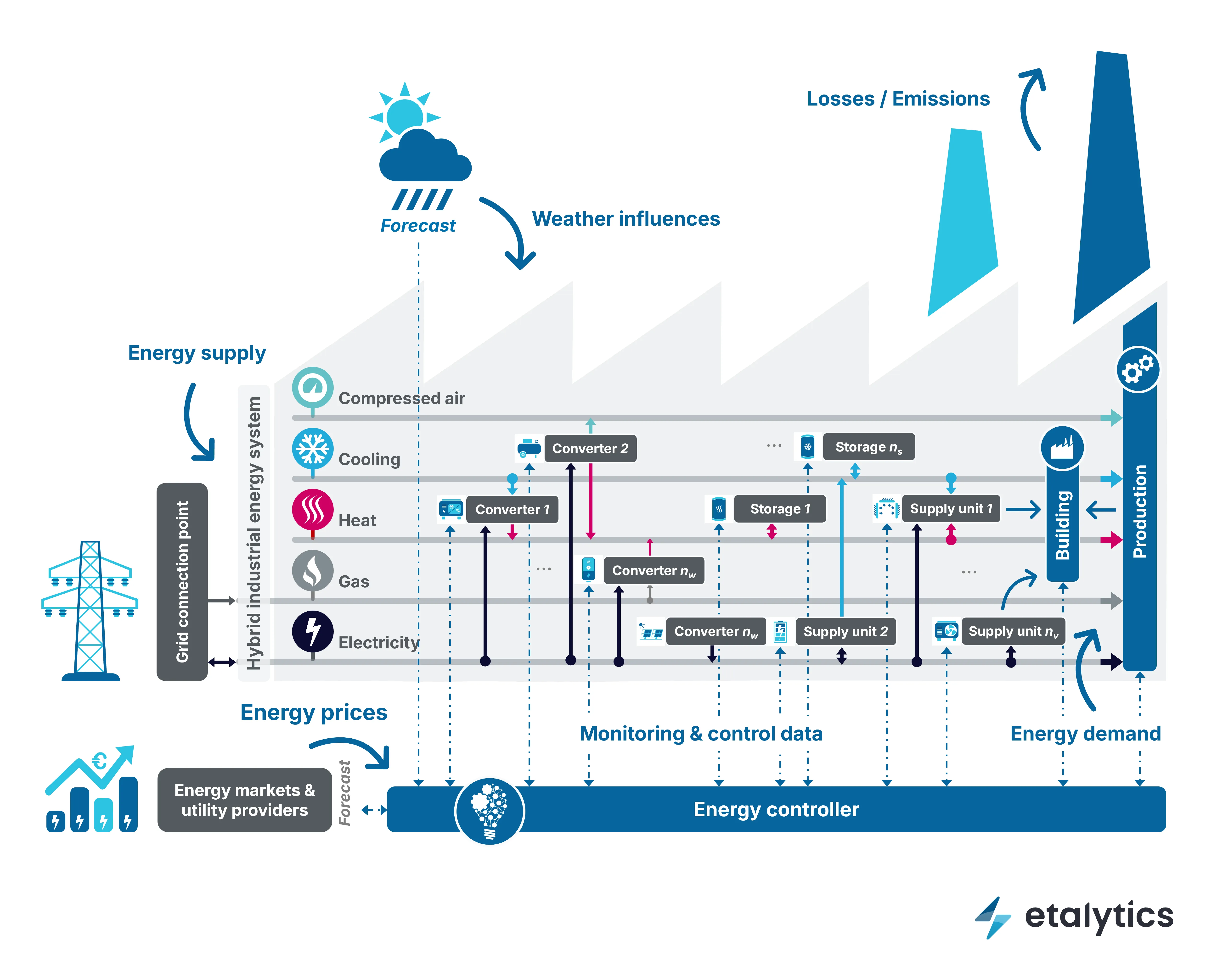
- interactions between assets (cooling ↔ process heat ↔ building ↔ storage)
Research on industrial demand-side response highlights the importance of coordinating production scheduling and power procurement to reduce cost and emissions. (Frontiers)
This is also why the industry is rapidly moving toward:
- live telemetry (real-time monitoring of energy flows and assets)
- digital twins (models that capture energy dynamics and constraints)
- predictive analytics and forecasting (load + price forecasting)
Digital twin research specifically points to step improvements in industrial energy management and optimization and better integration with renewable energy at site/local level. (ScienceDirect)
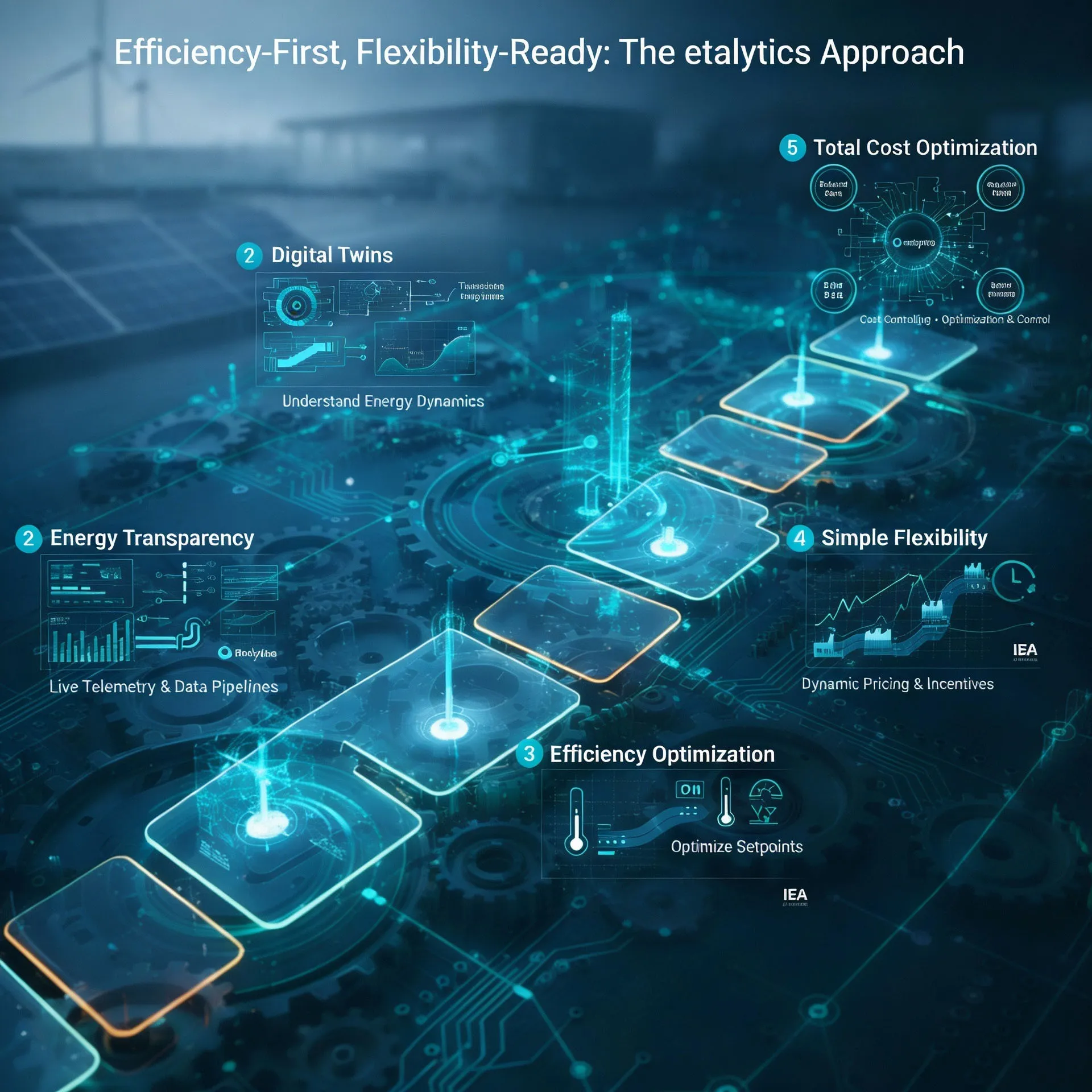
A practical roadmap: “efficiency-first, flexibility-ready” (the etalytics approach)
From dozens of industrial programs, one pattern repeats: flexibility works best when it’s layered on a stable efficiency foundation.
Step 1: Build energy transparency with live telemetry
Start with real-time monitoring of energy flows and assets, clear baselines, and reliable data pipelines. (This is the prerequisite for any serious optimization or ISO 50001-style EnPI system.) (etalytics)
Step 2: Create digital twins to understand energy dynamics
To shift load safely, you need to know:
- thermal inertia, ramp limits
- stability constraints (temperatures, humidity, pressure)
- cross-couplings (e.g., cooling demand driven by production + weather)
Digital twins enable scenario simulation (“what-if”) and safer optimization. (etalytics)
Step 3: Optimize dynamic setpoints for energy efficiency
Before monetizing flexibility, eliminate waste:
- control loops tuned for efficiency
- reduced over-conditioning (especially HVAC, cooling, ventilation)
- stable quality and compliance
etalytics positions its platform to optimize energy flows in real time to reduce consumption, emissions, and costs. (etalytics)
Step 4: Add simple flexibility via dynamic pricing incentives
Start with “implicit DR”:
- time-of-use or spot-indexed price signals
- internal incentives for shifting non-critical loads
- demand/price forecasting + scheduling rules
This aligns with how demand response is often scaled: price signals and incentives drive shifting. (IEA)
Step 5: Optimize for total cost: markets + grid costs + efficiency
Now the real win: multi-objective optimization that simultaneously considers:
- energy efficiency (kWh, stability, quality)
- grid costs (peak shaving, Netzentgelte logic, tariff constraints)
- market-adaptive flexibility (procurement + flexibility revenues)
This is exactly where platforms that combine forecasting + optimization + control reduce operational burden – because manual rule sets can’t keep up with “too many assets, too many variables.” (etalytics)
The bottom line
Energy efficiency is still the “first fuel.” But in an era of volatile prices and peak-driven grid costs, efficiency alone can leave significant money on the table.
Energy flexibility is the strategy that converts volatility into advantage – but only if it’s implemented with the same engineering discipline as efficiency: transparency, models, constraints, and optimization.
The industrial leaders will be those who can run a single, coherent system that:
- measures and benchmarks (Energy Transparency)
- predicts (Energy Foresight)
- optimizes and controls (Energy Autonomy)
…across consumption, storage, and generation – in real time. (etalytics)