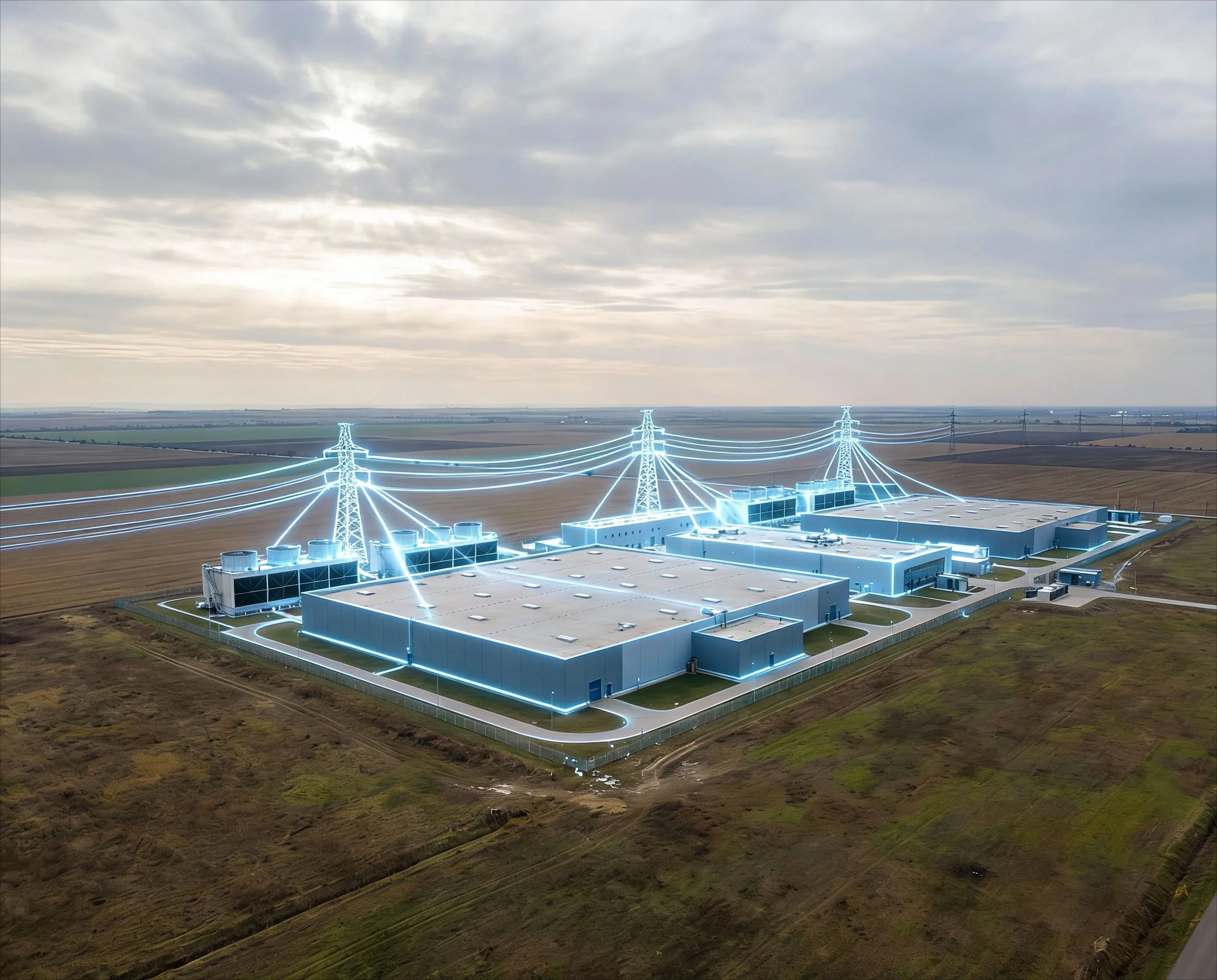
EISKIG was a research project focused on improving the efficiency of industrial cooling systems through AI-based optimization. The project demonstrated how data-driven control, digital twins, and intelligent operational strategies could reduce energy consumption in complex industrial environments.
Industrial cooling systems were often still operated with conventional control logic, such as two-point or PID control. However, key influencing factors like weather conditions, internal loads, electricity prices, and system-specific operating behavior had a major impact on performance and energy costs.
EISKIG addressed this challenge by applying AI methods to identify and implement better operating strategies for industrial cooling supply systems.
About the EISKIG Research Project
EISKIG was initiated to explore how artificial intelligence could improve the operation of industrial energy systems, with a particular focus on cooling infrastructure. The project combined system understanding, real operational data, and advanced optimization methods to create a more adaptive and energy-efficient way of controlling complex plants. The project showed how research could move beyond theory and generate measurable value in real industrial applications.
Research Focus and Objectives
The EISKIG research project focused on the development and validation of an intelligent optimization approach for industrial cooling systems. Its core objectives included:
- increasing energy efficiency in live operation
- reducing the complexity of implementation
- enabling transfer to additional industrial applications
By addressing the dynamic and site-specific nature of cooling systems, EISKIG contributed to the development of scalable AI solutions for industrial energy optimization.
How the Research Approach Worked
At the core of EISKIG was a digital twin of the cooling system. This virtual representation of the real plant enabled a stable understanding of system behavior and allowed operating scenarios to be tested before strategies were applied in practice.
Based on this system model, the project used:
- data analysis and forecasting
- mathematical optimization
- AI-based control methods
- deep reinforcement learning
This combination made it possible to identify inefficiencies, evaluate possible operating strategies, and continuously optimize system performance in real operation.
Validated Under Real Operating Conditions
A key strength of EISKIG was its practical validation. The research project did not stop at simulation or concept development but demonstrated that AI-based optimization could deliver measurable efficiency improvements in real industrial environments. This made EISKIG a relevant example of applied research in the field of industrial cooling, energy management, and AI for sustainable operations.
From Research Project to Scalable Application
EISKIG also highlighted the transfer potential of AI in industrial energy systems. The developed approach is not limited to one specific plant configuration but could be transferred to other cooling applications as well as to heating and HVAC systems.
This make the project highly relevant not only from a research perspective, but also for companies looking for proven approaches to improve energy efficiency and operational performance.
Key facts
Project duration: 09/2022 – 12/2025
Funding: German Federal Ministry for Economic Affairs and Energy (BMWE)
Project Management Agency: Projektträger Jülich | Forschungszentrum Jülich GmbH
Consortium Partners: PTW TU Darmstadt, ETA-Solutions GmbH, Merck KGaA, Bosch Rexroth AG, Equinix Deutschland GmbH, etalytics GmbH
Want to go deeper?
EISKIG – Produktionsmanagement, Technologie und Werkzeugmaschinen – TU Darmstadt
Merck senkt durch KI-Einsatz Energieverbrauch bei industrieller Kühlung deutlich, pharmaindustrie-online.de, February 11, 2026
Pharmakonzern Merck spart dank KI-Technologie, FAZ – Frankfurter Allgemeine, February 11, 2026
https://www.linkedin.com/posts/energieforschung_ki-activity
https://www.energieforschung.de/de/aktuelles/new